https://www.cbc.ca/news/indigenous/residential-school-denialism-explainer-1.7485959
Residential school denialism: what is it and how to recognize it
Denialism is about misrepresenting and minimizing residential school truths, say experts


Residential school denialism does not deny the existence of the school system, but rather downplays, excuses or misrepresents facts about the harms caused by it, experts say.
Earlier this month, B.C. MLA Dallas Brodie was kicked out of the Conservative Party caucus after she made a series of comments questioning Indigenous people’s experiences of residential schools.
In a post on X, Brodie responded by saying she was simply speaking the truth. She has previously told CBC News she refutes claims that she has been engaging in residential school denialism.
However, experts, including historian Sean Carleton, say Brodie’s comments are part of the “predictable” and “rigorously debunked” arguments used frequently by residential school deniers.
“I think it’s important to define what residential school denialism is not, which is the denial of the system’s existence or even that the system had some negative effects. We don’t see a lot of that,” said Carleton, who is also an assistant professor of Indigenous studies at the University of Manitoba.
Instead, he said, denialism is “a strategy to twist, downplay, misrepresent, minimize residential school truths in favour of more controversial opinions that the system was well-intentioned.”
He said denialism in all forms — whether talking about climate change or flat Earth conspiracies — is “an attempt to shake public confidence in something that we have consensus about.”
Sowing doubt
Patterns in behaviour, Carleton said, can help distinguish those who are asking questions in good faith from those who are trying to sow doubt. In Brodie’s case, he said there were multiple instances where her comments failed to address the full reality of residential schools.

“If you call Brodie, for example, a denier, she’ll say, ‘But I’m not denying — this is the truth. The truth is that they haven’t found any bodies yet,’” he said.
“But then when you do the homework and you look at the pattern of what she’s doing … she’s not actually saying, ‘Well, we know that 4,000 children have died in that system [with] 50 confirmed at Kamloops.’”
WATCH | How do experts define denialism?

Hear from experts on what residential school denialism is and is not, and why that matters.
Crystal Gail Fraser, who is Gwichyà Gwich’in and an associate professor in history and Native studies at the University of Alberta, said she thinks about residential school denialism in terms of “little grey areas.”
Like Carleton, she thinks it’s important to note denialism is not about saying residential schools never happened.
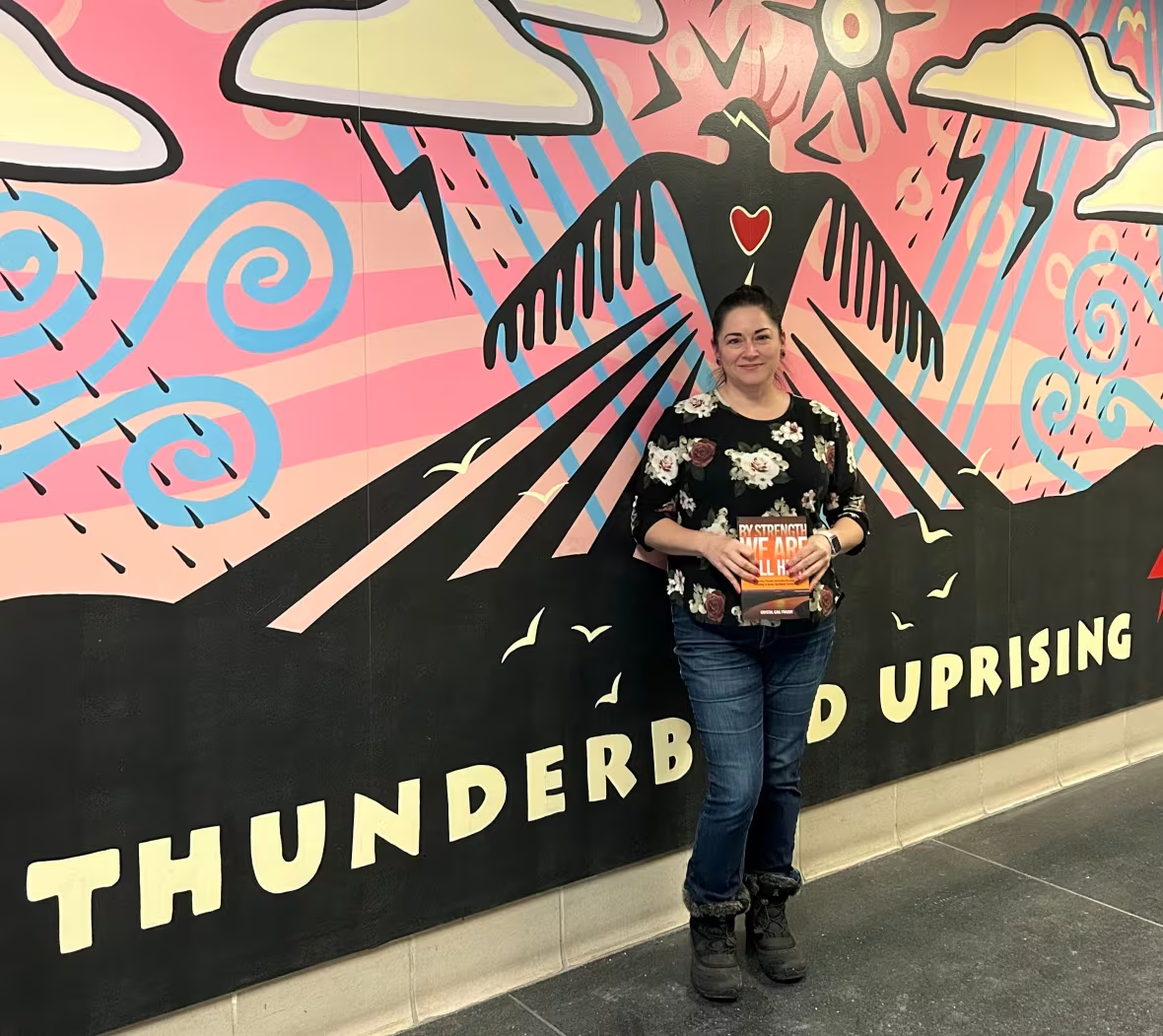
“[It’s about] denying survivors’ experiences, how they experienced their institutionalization as a child, but also the so-called intent of residential schools,” she said.
Fraser said she sees denialism when people suggest the residential school system had good intentions, as well as when people question the motives of survivors who share their stories.
She said denialism will still exist even after all the facts about residential schools are accepted.
“The ideology of denialism is going to continue beyond residential schools because we still live in a sociopolitical context that justifies colonialism,” she said.
“In order to interrupt the rejection of Indigenous knowledge, whether it’s about residential schools or something else, we will need some kind of a radical transformation in society.”
Discrediting survivors
Ry Moran, founding director of the National Centre for Truth and Reconciliation and associate university librarian – reconciliation at the University of Victoria, said it’s important to him that survivors are centred when thinking about denialism.
Moran, who is Métis, said he defines IRS denialism “as the action or actions that seek to diminish the truths shared by residential school survivors.”
“I think one of the worst goals of denialism is to discredit the truths of residential school survivors,” he said.

Moran worked with the Truth and Reconciliation Commission (TRC) gathering survivor testimony from thousands of people, and points out that the TRC was just one of several efforts to document the truth about residential schools, alongside the Royal Commission on Aboriginal Peoples.
“We have an inordinate amount of truth on what occurred inside of the residential schools thanks to all of these collective efforts,” he said.
“[Survivors] have been remarkably consistent in everything that they have said. And time and time again … what we found in the ground, what we found in the archives, or what we found in other sources has verified what they’ve told us.”
Denialism, he said, has been around since the earliest days of the residential school system; kids who ran away and reported abuses were not believed or taken seriously, despite the fact that beatings and abuse were often witnessed by other students, Moran said.
A crime?
Leah Gazan, MP for Winnipeg Centre, tabled a bill in Parliament last year that would have amended the Criminal Code to criminalize residential school denialism.
Gazan’s bill refers to “condoning, denying, downplaying” facts — identical language to the law outlawing Holocaust denial — but adds “justifying the Indian residential school system in Canada or by misrepresenting facts relating to it.”
“Indigenous people have a right to be protected from the incitement of hate like Holocaust denial,” she said.
With an election expected soon, Gazan’s bill is unlikely to move forward. She said if she’s re-elected, she will bring the bill back to Parliament.
ABOUT THE AUTHOR

,,,,
https://beyond.ubc.ca/8-ways-to-confront-residential-school-denialism/
Truth before reconciliation: 8 ways to identify and confront Residential School denialism
By Dr. Daniel Heath Justice and Dr. Sean Carleton

In its 2015 final report, the Truth and Reconciliation Commission was clear: “Without truth … there can be no genuine reconciliation.” The problem, the commissioners explained, is that “too many Canadians know little or nothing about the deep historical roots” of the ongoing issues stemming from settler colonialism generally and residential schooling specifically.
Embracing truth is all the more difficult for some because many Canadians still associate residential schooling with the positive images church and state officials used to propagandize and promote these institutions as humanitarian projects.
Such “positive” framings of residential schools justify ongoing colonial policy approaches that continue to harm Indigenous Peoples today.
Rejection, misrepresentation of basic facts
But lack of accurate historical knowledge is not the only barrier to truth and genuine reconciliation. There are a handful of figures — former senator Lynn Beyak, Conservative Party Leader Erin O’Toole, Conrad Black and others — who have openly engaged in denialism.
Residential school denialism is not the outright denial of the Indian Residential School (IRS) system’s existence, but rather the rejection or misrepresentation of basic facts about residential schooling to undermine truth and reconciliation efforts.
Residential school denialists employ an array of rhetorical arguments. The end game of denialism is to obscure truth about Canada’s IRS system in ways that ultimately protect the status quo as well as guilty parties.
Residential school denialists begin and end with a firm belief in innate Indigenous deficiency and settler innocence, often rooted in Christian triumphalism. Their ranks include missionary apologists, writers and academics, right-wing and anti-Indigenous editorialists and relatives of residential school staff who uncritically refer to personal memory and work to defend their family reputations. These are neither informed nor objective commentators.
Avoiding truth, rushing reconciliation
Murray Sinclair, the TRC’s chair, has recently argued that residential school denialism is on the rise and real reconciliation is at risk.
Canada, Sinclair suggests, is rushing reconciliation and leaving the truth behind. In light of recent announcements of unmarked children’s graves across the country, now is the time to confront the truth about Canada’s IRS system and, in the process, disprove and discredit denialism.
The following glossary is the start of an inventory of some common contortions used by denialists to try to undermine the overwhelming documentary and testimonial evidence of widespread, multigenerational, systemic and ongoing violence of the IRS system.
1. Genocide: The destruction, in whole or in part, of a nation or an ethnic group. In spite of the United Nation’s expansive official definition, denialists strategically narrow the term “genocide” to ethnic cleansing events modelled on the Holocaust. Contrary to historical evidence, denialists contend that genocide is not applicable to Canada.
The TRC’s final report shows how Canada’s treatment of Indigenous Peoples fits the definition of genocide, specifically explaining how the residential school system was a form of “cultural genocide.” Some denialists jump on this categorization to suggest that “cultural” genocide is not genocide. That is incorrect. The Canadian Historical Association has recently clarified that genocide is, in fact, the correct term to be using in the Canadian context.
2. School: A place where children are taught a variety of academic subjects. Physical assault, sorting of children according to racist assumptions and on the basis of ability and class have long histories in Canadian education. But the particular combination of factors distinguish residential schools from comparative schooling contexts. These factors include: racist assimilationism; cultural shaming and sexual violence combined with multi-generational collusion of church and state; the explicit aim of isolating children to neutralize community resistance to government control.
Denialists often make false comparisons between boarding schools and the violent carceral institutions known as “residential schools.” Canadian policy meant that for more than 100 years and multiple generations, Indigenous children were removed from their families and cultures to institutions where many were abused, malnourished, trafficked to local white families and inflicted with substandard education focused on manual labour and servitude — while government also systemically dispossessed Indigenous lands and resources.
3. “But they learned new skills”: Given little meaningful academic or effective vocational instruction, “new skills” taught in residential institutions included religious indoctrination enforced by corporal punishment and myriad forms of abuse, cultural and bodily shame, alienation from family, disconnection from subsistence economies and substandard orientation for wage labour.
Church and state officials often justify this “education” in humanitarian — even sacred — terms. But all of these “skills” directly supported the destruction of Indigenous ways of life and the ostensible training of children and youth for lower-class “productive” service positions. Indigenous children were not put on vocational or professional paths towards economic or social competition in Canada’s capitalist settler society.
4. “They had good intentions”: No matter how many bodies are found, how many people testify to the lifelong traumas of extensive abuse at the hands of church officials and teachers, denialists evoke the “good intentions” of some school officials as justification for their maintenance of a genocidal school system for over a century.
5. “You’re ignoring all the good things”: Anything at all that made life bearable under a dominant violent context of staff-inflicted cruelties, deprivations and separations from friends, family and home is cited by denialists as a “good” of residential schooling to absolve churches of culpability. Denialists insist on focusing on a minority of individualized, positive recollections from the schools as part of a strategy to discredit those who draw attention to the overall, systemic genocidal effects of the IRS system. Even the Anglican Church of Canada, which ran approximately 30 per cent of residential schools across the country, has clarified that “there was nothing good” about a school system that sought to “kill the Indian in the child.”
6. Balance: An equal weighting of different elements. Denialists often engage in a form of bias known as “false balance” to wrongly suggest that the “good” and the “bad” of residential schooling were equal parts of the “whole story.” The insistence on focusing on “positives” to provide “balance” fundamentally misrepresents the scholarly consensus, supported by overwhelming survivor testimony and backed by historical research, that the overall effects of the system are genocidal.
7. “It was of the times”: The idea that we can’t judge the past by the values of today. This notion wrongly suggests that no one judged the IRS system harshly during its operation. In fact, Indigenous parents, students and community leaders, church employees and even the Department of Indian Affairs’ own medical expert critiqued the system “in their own times.” However, powerful church and state officials chose to downplay and discredit dissent and resistance for over a century to protect the IRS system so that it could continue to support settler colonialism and Canadian nation-building — as a way of protecting their assets and defend against litigation.
8. Civility: What some settlers demand from Indigenous people when their denialism is publicly called out, challenged and discredited. Indigenous anger, sadness and refusal are labelled as uncivil and excluded from so-called mainstream dialogue. By contrast, our public institutions accommodate public settler anger and outrage used to defend denialists.
Overall, residential school denialism is a strategy used to manipulate and undermine the realities of Indigenous Peoples’ painful experiences under Canadian colonialism to protect the status quo. An honest accounting of the past makes possible an honourable future — but only if Canadians have the courage to face it. As the TRC reminds us, we must have truth before reconciliation — anything less will only perpetuate the harms of that history.
If you are an Indian Residential School survivor, or have been affected by the residential school system and need help, you can contact the 24-hour Indian Residential Schools Crisis Line: 1-866-925-4419
Dr. Daniel Heath Justice is a Cherokee Nation citizen and Professor of Critical Indigenous Studies and English at UBC.
Dr. Sean Carleton is an Assistant Professor with the Departments of History and Indigenous Studies at the University of Manitoba.
This article is republished from The Conversation under a Creative Commons license. Read the original article. To republish this article, please refer to the original article.
https://theconversation.com/truth-before-reconciliation-8-ways-to-identify-and-confront-residential-school-denialism-164692

Truth before reconciliation: 8 ways to identify and confront Residential School denialism


Disclosure statement
Daniel Heath Justice receives funding from the Social Sciences and Humanities Research Council of Canada.
Sean Carleton receives funding from the Social Sciences and Humanities Research Council of Canada.
Partners

University of Manitoba and University of British Columbia provide funding as founding partners of The Conversation CA.
University of British Columbia and University of Manitoba provide funding as members of The Conversation CA-FR.
Languages
- Français
- English
DOI

In its 2015 final report, the Truth and Reconciliation Commission was clear: “Without truth … there can be no genuine reconciliation.” The problem, the commissioners explained, is that “too many Canadians know little or nothing about the deep historical roots” of the ongoing issues stemming from settler colonialism generally and residential schooling specifically.
Embracing truth is all the more difficult for some because many Canadians still associate residential schooling with the positive images church and state officials used to propagandize and promote these institutions as humanitarian projects.
Such “positive” framings of residential schools justify ongoing colonial policy approaches that continue to harm Indigenous Peoples today.
Rejection, misrepresentation of basic facts
But lack of accurate historical knowledge is not the only barrier to truth and genuine reconciliation. There are a handful of figures — former senator Lynn Beyak, Conservative Party Leader Erin O’Toole, Conrad Black and others — who have openly engaged in denialism.
Residential school denialism is not the outright denial of the Indian Residential School (IRS) system’s existence, but rather the rejection or misrepresentation of basic facts about residential schooling to undermine truth and reconciliation efforts.
Residential school denialists employ an array of rhetorical arguments. The end game of denialism is to obscure truth about Canada’s IRS system in ways that ultimately protect the status quo as well as guilty parties.
Residential school denialists begin and end with a firm belief in innate Indigenous deficiency and settler innocence, often rooted in Christian triumphalism. Their ranks include missionary apologists, writers and academics, right-wing and anti-Indigenous editorialists and relatives of residential school staff who uncritically refer to personal memory and work to defend their family reputations. These are neither informed nor objective commentators.
Avoiding truth, rushing reconciliation
Murray Sinclair, the TRC’s chair, has recently argued that residential school denialism is on the rise and real reconciliation is at risk.
Canada, Sinclair suggests, is rushing reconciliation and leaving the truth behind. In light of recent announcements of unmarked children’s graves across the country, now is the time to confront the truth about Canada’s IRS system and, in the process, disprove and discredit denialism.

The following glossary is the start of an inventory of some common contortions used by denialists to try to undermine the overwhelming documentary and testimonial evidence of widespread, multigenerational, systemic and ongoing violence of the IRS system.
1. Genocide: The destruction, in whole or in part, of a nation or an ethnic group. In spite of the United Nation’s expansive official definition, denialists strategically narrow the term “genocide” to ethnic cleansing events modelled on the Holocaust. Contrary to historical evidence, denialists contend that genocide is not applicable to Canada.
The TRC’s final report shows how Canada’s treatment of Indigenous Peoples fits the definition of genocide, specifically explaining how the residential school system was a form of “cultural genocide.” Some denialists jump on this categorization to suggest that “cultural” genocide is not genocide. That is incorrect. The Canadian Historical Association has recently clarified that genocide is, in fact, the correct term to be using in the Canadian context.
Read more: Canada’s hypocrisy: Recognizing genocide except its own against Indigenous peoples
2. School: A place where children are taught a variety of academic subjects. Physical assault, sorting of children according to racist assumptions and on the basis of ability and class have long histories in Canadian education. But the particular combination of factors distinguish residential schools from comparative schooling contexts. These factors include: racist assimilationism; cultural shaming and sexual violence combined with multi-generational collusion of church and state; the explicit aim of isolating children to neutralize community resistance to government control.
Denialists often make false comparisons between boarding schools and the violent carceral institutions known as “residential schools.” Canadian policy meant that for more than 100 years and multiple generations, Indigenous children were removed from their families and cultures to institutions where many were abused, malnourished, trafficked to local white families and inflicted with substandard education focused on manual labour and servitude — while government also systemically dispossessed Indigenous lands and resources.
3. “But they learned new skills”: Given little meaningful academic or effective vocational instruction, “new skills” taught in residential institutions included religious indoctrination enforced by corporal punishment and myriad forms of abuse, cultural and bodily shame, alienation from family, disconnection from subsistence economies and substandard orientation for wage labour.
Church and state officials often justify this “education” in humanitarian — even sacred — terms. But all of these “skills” directly supported the destruction of Indigenous ways of life and the ostensible training of children and youth for lower-class “productive” service positions. Indigenous children were not put on vocational or professional paths towards economic or social competition in Canada’s capitalist settler society.
4. “They had good intentions”: No matter how many bodies are found, how many people testify to the lifelong traumas of extensive abuse at the hands of church officials and teachers, denialists evoke the “good intentions” of some school officials as justification for their maintenance of a genocidal school system for over a century.
5. “You’re ignoring all the good things”: Anything at all that made life bearable under a dominant violent context of staff-inflicted cruelties, deprivations and separations from friends, family and home is cited by denialists as a “good” of residential schooling to absolve churches of culpability. Denialists insist on focusing on a minority of individualized, positive recollections from the schools as part of a strategy to discredit those who draw attention to the overall, systemic genocidal effects of the IRS system. Even the Anglican Church of Canada, which ran approximately 30 per cent of residential schools across the country, has clarified that “there was nothing good” about a school system that sought to “kill the Indian in the child.”
6. Balance: An equal weighting of different elements. Denialists often engage in a form of bias known as “false balance” to wrongly suggest that the “good” and the “bad” of residential schooling were equal parts of the “whole story.” The insistence on focusing on “positives” to provide “balance” fundamentally misrepresents the scholarly consensus, supported by overwhelming survivor testimony and backed by historical research, that the overall effects of the system are genocidal.
7. “It was of the times”: The idea that we can’t judge the past by the values of today. This notion wrongly suggests that no one judged the IRS system harshly during its operation. In fact, Indigenous parents, students and community leaders, church employees and even the Department of Indian Affairs’ own medical expert critiqued the system “in their own times.” However, powerful church and state officials chose to downplay and discredit dissent and resistance for over a century to protect the IRS system so that it could continue to support settler colonialism and Canadian nation-building — as a way of protecting their assets and defend against litigation.
8. Civility: What some settlers demand from Indigenous people when their denialism is publicly called out, challenged and discredited. Indigenous anger, sadness and refusal are labelled as uncivil and excluded from so-called mainstream dialogue. By contrast, our public institutions accommodate public settler anger and outrage used to defend denialists.
Overall, residential school denialism is a strategy used to manipulate and undermine the realities of Indigenous Peoples’ painful experiences under Canadian colonialism to protect the status quo. An honest accounting of the past makes possible an honourable future — but only if Canadians have the courage to face it. As the TRC reminds us, we must have truth before reconciliation — anything less will only perpetuate the harms of that history.
If you are an Indian Residential School survivor, or have been affected by the residential school system and need help, you can contact the 24-hour Indian Residential Schools Crisis Line: 1-866-925-4419
Facing the Facts: Why Residential School Denialism Must Be Called Out
Facing the Facts: Why Residential School Denialism Must Be Called Out
Content warning: This post contain information about residential schools. Mental health support is available.
In February 2025, a troubling story out of British Columbia made headlines and reignited a painful conversation.
Dallas Brodie, a former Member of the Legislative Assembly of the BC Conservative Party, publicly supported lawyer James Heller, who had filed a legal challenge against a mandatory cultural competency course for lawyers in the province. The course includes education about residential schools and the findings at the former Kamloops Residential School site.
Heller’s objection? He claimed the Law Society of BC was misleading the public by not emphasizing the word “potential” when describing the 215 unmarked graves detected through ground-penetrating radar in Kamloops. Brodie doubled down on this rhetoric, stating that the number of “confirmed child burials” at Kamloops was zero, despite the fact that the Tk’emlúps te Secwépemc First Nation had already confirmed the findings based on both technology and community knowledge.
These remarks were quickly and widely condemned.
An Act of “Racist Residential School Denialism”
The Union of BC Indian Chiefs called Brodie’s comments an act of “racist residential school denialism,” and demanded a public apology to Survivors. Indigenous leaders and organizations emphasized that this kind of language, framing the findings as speculative, ultimately ignores the oral histories and lived experiences of Indigenous people.
Just days later, Brodie was expelled from the Conservative caucus.
What is Residential School Denialism and Why is it a Concern?
Residential school denialism doesn’t always come in the form of outright rejection of history. More often, it shows up as doubt, deflection, and demands for more “proof”—even in the face of well-documented truth.
It’s not just offensive. It’s dangerous.
Denying, minimizing, or reframing the violence and deaths that took place in residential schools retraumatizes Survivors, undermines truth-telling, and halts progress toward reconciliation.
The Truth and Reconciliation Commission of Canada (TRC) made clear that more than 150,000 Indigenous children were taken from their families and placed in residential schools—many never returned home. The TRC documented thousands of deaths and stated that the true number is likely much higher.
Since 2021, Indigenous communities across the country have been leading investigations at former residential school sites, using ground-penetrating radar to locate unmarked graves. These are not discoveries—they are confirmations of what Survivors and families have been telling us for generations.
Language Matters
When people like Heller and Brodie question whether the graves in Kamloops are “confirmed,” they’re not just scrutinizing a word. They’re casting doubt on the lived truth of Survivors.
The word “recovery” is used intentionally by many Indigenous communities. Not because the children were lost, but because they were taken. These are not new truths—they are truths that have finally been acknowledged by wider Canada. Words like “discovery” or “alleged” erase that.
What We Can Do
If you’re reading this, you likely care deeply about truth, justice, and reconciliation. So, what can we do when denialism shows up?
- Call it out. When you see misinformation, whether in the news, online, or in conversation, correct it. Share verified facts and Indigenous-led sources.
- Centre Survivors. Trust the stories of those who lived through residential schools. Share and uplift their voices.
- Support Indigenous-led search and memorial efforts. Many communities are fundraising for ground searches, ceremonies, and healing.
- Educate yourself and others. Recommended reading below:
Truth Before Reconciliation
The 215+ Pledge exists to honour the children who never came home, and to call people into action—not just for a moment, but for the long haul.
The events of the past few months are a stark reminder that the truth is still under attack. And that’s why this work remains urgent.
Take the 215+ Pledge. Stand up to denialism and be a part of truth-telling.
Resources:
Residential School History – NCTR
About the Author
Quinn Roffey- Antoine is Plains Cree from Poundmaker Cree Nation in Treaty 6 Territory. She grew up in Toronto, Ontario and resides there now.
,,,
https://www.bcafn.ca/news/fnlc-calls-canada-prioritize-legislation-create-legal-protections-against-residential-school
FNLC Calls on Canada to Prioritize Legislation to Create Legal Protections against Residential School Denialism
- Press Release
March 20, 2025
(xʷməθkʷəy̓əm (Musqueam), Sḵwx̱wú7mesh (Squamish) and səlilwətaɬ (Tsleil-Waututh)/Vancouver, B.C.) The First Nations Leadership Council (FNLC) is deeply concerned by the rise of Residential School denialism in the province, particularly the egregious misuse of public office by elected officials using their platforms to sow public doubt and promote misinformation and anti-Indigenous racism. The FNLC calls for the government of Canada to prioritize implementation of federal legislation to protect against Residential School denialism, as has been done with Bill C-19 which criminalized Holocaust denialism in Canada.
First Nations leadership across B.C. have passed resolutions at the B.C. Assembly of First Nations and the Union of B.C. Indian Chiefs calling for the rights and testimony of survivors to be upheld, implementation of the Truth and Reconciliation Commission’s Calls to Action, rejection and criminalization of Residential School denialism, and denouncing recent comments made by then-Conservative MLA Dallas Brodie regarding unmarked graves and burial sites at the Kamloops Indian Residential School (UBCIC Resolution 2024-33; BCAFN #02/2025) A similar resolution will go forward to the next First Nations Summit meeting in April.
We commend MP Leah Gazan for introducing the Private Member’s Bill C-413 An Act to amend the Criminal Code (promotion of hatred against Indigenous peoples), which aimed to criminalize Residential School denialism, and hold individuals accountable for spreading hateful speech and misinformation about the Residential School system and Indigenous people. We feel strongly that legislation is needed to combat misinformation, denialism, and racism promoted by elected officials and hate groups. We urge the government of Canada to uphold its obligations under the UN Declaration on the Rights of Indigenous Peoples Act, the United Nations Declaration on the Rights of Indigenous Peoples, and the principles of reconciliation, and urge all members of Parliament to work across party lines to make it an offence to promote hatred against Indigenous peoples by condoning, denying, downplaying, or justifying Residential Schools in Canada or misrepresenting related facts.
“The language and actions of publicly elected officials significantly shape societal attitudes, influence public perceptions, and have the power to either foster understanding and healing or perpetuate division In her statements, MLA Brodie showed blatant disrespect for her position in public office by promoting harmful Residential School denialism on her social media. We are glad Mr. Rustad has removed MLA Brodie from the Conservative Party and believe that she is unfit to sit as an MLA in the legislature. It is essential that the governments of BC and Canada take a strong stance against Residential School denialism, by rightfully recognizing this harmful rhetoric as hate speech. Political leaders must acknowledge the gravity of traumas endured by Indigenous peoples at these institutions and must engage with First Nations and respectfully honour the stories of survivors. As a society we must foster dialogue that supports reconciliation, as all political leaders in BC work to implement the United Nations Declaration on the Rights of Indigenous Peoples,” stated B.C Assembly of First Nations Regional Chief, Terry Teegee.
“Residential School denialists try to hide facts from the public. They intentionally fail to acknowledge or mention the dozens of people convicted of, or who have pled guilty to, sexually and/or physically assaulting First Nations children in Residential Schools. They also neglect to speak about the thousands of abusers located by multiple private investigation firms contracted by the Federal Government,” said Hugh Braker of the First Nations Summit Political Executive. “These denialists purposely reject the words of the BC Supreme Court Judge, who at the sentencing of offender Henry Plint to 11 years in prison, stated that Residential Schools were ‘…factories for child abuse’ and that ‘the Federal Government has admitted that up to 6,000 Indian Residential School children died in Residential School.’” “Denying or ignoring the truth about one of the most horrendous parts of Canada’s history is an obstacle to reconciliation and does nothing except cause residential school survivors’ additional pain and suffering,” Braker concluded.
Grand Chief Stewart Phillip, UBCIC President concluded, “Indigenous peoples have been combating racism and suppression of our knowledge from the highest levels of government since the establishment of Canada, so it comes as no surprise that denialist views which aim to minimize the harms of Residential Schools and intentionally mislead and embolden the public against us endure within our public institutions. Residential School denialism is not about academic debate or questioning history in good faith, it is an ugly and thinly veiled attempt to sow doubt, belittle the experiences of survivors, and distort our shared knowledge from survivors and archival and archaeological research which detail the profound intergenerational harms of these institutions. I implore the current, and any subsequent government of Canada, to take bold legislative action to protect against the spread of dangerous anti-Indigenous racism and denialist rhetoric in equal measure to Holocaust denialism protections. We need only look to our southern neighbours to see the harrowing impacts of leaving hate unchecked.”
https://libguides.uvic.ca/residentialschooldenialism/today
Residential School Denialism
How widespread is residential school denialism?
Kimberly Murray, Independent Special Interlocutor for Missing Children and Unmarked Graves and Burial Sites associated with Indian Residential Schools shares her concerns on Residential School Denialism
Watch it here: CBC News
Residential School Denialism
Residential school denialism is a dangerous movement that seeks to distort the truth about Canada’s residential school system and its lasting impact on Indigenous communities. But why is this happening, and why should it matter to you?
Get the facts and understand the stakes by watching this powerful video:
“Residential school denialism is growing in Canada, threatening meaningful reconciliation. Following the Truth and Reconciliation Commission’s 2015 Final Report and the Tk’emlúps te Secwe?pemc Nation’s 2021 announcement about potential unmarked graves at the Kamloops Indian Residential School, denialism has gained traction among priests, pundits, and politicians. Denialists generally do not reject the existence of residential schools or their damaging effects but manipulate facts to undermine public trust in reconciliation efforts, defend those responsible, and preserve Canada’s colonial framework. Denialism peaks during significant dates, such as the Kamloops announcement anniversary (May 27) and Orange Shirt Day (September 30), often with far-right media and conspiracy theorists spreading misinformation” (Carleton et al., 2024).
While residential school denialism is a uniquely Canadian issue, experts emphasize that it is deeply connected to broader global trends. These include the rise of far-right movements and resistance to addressing the legacies of colonialism. Carmen Celestini, a lecturer at the University of Waterloo who studies far-right movements, notes that denialism has evolved over the past year, moving from fringe conspiracy circles to becoming a central talking point among white Christian nationalists. According to Celestini, these groups often frame discussions about residential schools as an attempt to “oppress white people and make white people feel guilt.” She adds that denialism frequently stems from a sense of alienation, particularly among predominantly white men.
Adherents to this ideology often align with right-wing narratives that claim “woke” actors are attacking “white people’s history.” Celestini explains that their trusted sources include figures like Jordan Peterson and Joe Rogan, who interpret world events through a lens of conspiracy, bias, or hate. This phenomenon is not limited to Canada; similar pushback has been observed in the United Kingdom and the United States, where efforts to confront colonial histories, slavery, and systemic racism have been met with resistance. As University of Manitoba professor Sean Carleton notes, these groups often defend colonialism as “humanitarian” and “benevolent,” while employing racist rhetoric that undermines Indigenous authority. “Residential school denialism needs to be understood as part of this larger global movement,” Carleton emphasizes.
In Canada, as public awareness of residential schools has grown, conservative voices have opposed efforts to remove statues or rename institutions linked to figures like John A. Macdonald and Egerton Ryerson, who played key roles in establishing the residential school system. This resistance highlights the ongoing struggle to reconcile with Canada’s colonial past.
For a thorough and recent update on this issue, scan the QR code below to access the full article from Al Jazeera, which provides an in-depth exploration of residential school denialism and its global connections:

References:
Expert Panel – Confronting Indian Residential School Denialism
“In the psychology of human behaviour, denialism is a person’s choice to deny reality as a way to avoid believing in a psychologically uncomfortable truth. In this case, it is a way to maintain the fundamentally oppressive nature of colonial dominance and oppression of Indigenous peoples and lands, and their exploitation. Michelle Good’s presentation focuses on the dynamics and politics of denialism as a continuation of colonial violence.” –Michelle Good, 2024, November 14, First Nations House of Learning Event
Truth Before Reconciliation: How to Identify and Confront Residential School Denialism presented in UBC. by Dr. Sean Carleton, Michelle Good, and Andrew Martindale

Watch the video: Truth Before Reconciliation: How to Identify and Confront Residential School Denialism
https://www.aljazeera.com/news/longform/2025/2/7/denying-our-truth-fighting-residential-school-denialism-in-canada
Denying our truth’
The fight against residential school denialism in Canada


Warning: The story below contains details of residential schools that may be upsetting. Canada’s Indian Residential School Survivors and Family Crisis Line is available 24 hours a day at 1-866-925-4419.
Geraldine Shingoose spent nearly a decade of her childhood far from her family, at a boarding school she could not freely leave.
But it took many years after she got away from the Muscowequan Residential School, in the Canadian province of Saskatchewan, before she was able to speak about what had happened to her there.
“Our history, the history of residential school, was never taught. It wasn’t until the early 1990s when all these stories started coming out,” says Shingoose, 67, who attended Muscowequan from 1962 to 1971.
“I carried my story for a long time without sharing, and it definitely had an impact on my whole wellbeing, emotionally and mentally.”
Shingoose is among the more than 150,000 Indigenous children across Canada who were forced to attend residential schools between the 1870s and 1990s.
They were separated from their families, stripped of their cultures and languages, and subjected to widespread physical, psychological and sexual abuse.
Thousands are believed to have died at the institutions. One government official who oversaw the school system said in 1920 that it was designed to “get rid of the Indian problem”.

Today, nearly 30 years after the last residential school in Canada shut its doors, the intergenerational trauma of the system continues to be felt in First Nation, Metis and Inuit communities.
In 2021, the discoveries of unmarked graves believed to contain children’s remains on the grounds of former institutions pushed the issue to the fore once again, forcing Canadians to confront their country’s harmful legacy of colonialism.
But after this brief moment of reckoning, experts say the pendulum is now swinging in the opposite direction: An alarming trend of residential school denialism is gaining ground – and pouring salt on the wounds of survivors, their families and their communities.
“When people deny our stories, they’re denying my truth. They’re denying my abuses that I experienced in residential school – the mental, emotional, physical, spiritual and sexual abuse that I experienced,” Shingoose told Al Jazeera.
“They’re trying to share a fake, different story about Canada’s history, and they’re denying our truth.”
What is residential school denialism?

That Indigenous children were subjected to human rights abuses at residential schools is not new information.
While it took a long time for survivors like Shingoose to speak about what happened, their experiences – and the widespread harm they suffered – have been a matter of public record for decades.
Funded by the government and run by churches, including, most notably, the Roman Catholic Church, the schools aimed to forcibly assimilate Indigenous children into Canada’s predominantly white European culture.
In 2015, a federal commission charged with investigating the system – the Truth and Reconciliation Commission of Canada (TRC) – laid out mountains of evidence of systemic abuses, neglect and harm. It concluded that the schools amounted to “cultural genocide”.

Thousands of children died at the institutions, the commission said, but “no one took care to count how many died or to record where they were buried”.
Residential school denialists don’t necessarily disagree that the system existed, nor do they refute that abuses occurred, according to Sean Carleton, a history professor at the University of Manitoba.
Instead, Carleton says residential school denialism is often much more insidious.
Residential school denialism can be defined as “the rejection, the twisting or [the] misrepresentation of basic facts about residential schooling”, Carleton told Al Jazeera.
It’s similar to other trends like climate change denialism, where individuals sow doubt in well-established facts.
Some denialist arguments include that residential schools were “well-intentioned”, that abuses have been exaggerated, or that those who ran the institutions were simply trying to educate the children.

Denialists argue that deaths didn’t happen or, if they did, they were unavoidable and the overall policy was not genocidal. Others question why the “positives” of residential schools are not brought up more often.
In recent years, such denialism has been propagated in books and via right-wing media outlets such as The National Post, True North and Rebel News.
Prominent figures in Canada also have engaged in forms of denialism, including former Conservative Party leader Erin O’Toole, who in 2020 had to walk back a statement he made that residential schools had been designed to “provide education”.
In one of the most glaring examples in recent memory, a Canadian senator drew rebuke in 2017 for saying “there are shining examples from sea to sea of people who owe their lives to the schools” – and then refusing to get “any more education” on the issue.
Carleton said that while most denialist arguments have been thoroughly debunked – both by residential school survivors and the historical record – the truth matters little to bad-faith actors.
“What they’re trying to do is shake public confidence in the truth, to close off the avenues to healing and justice and reconciliation,” Carleton said. “Because what they want is to keep the colonial status quo intact.”
‘Some came in the middle of the night’

In May 2021, that “colonial status quo” was shaken by an announcement in Canada’s westernmost province of British Columbia.
Tk’emlups te Secwepemc, a First Nation near the city of Kamloops, announced that a preliminary radar search of the grounds of Kamloops Indian Residential School had uncovered what were believed to be the remains of 215 children.
“To our knowledge, these missing children are undocumented deaths,” Kukpi7 Rosanne Casimir said at the time (PDF). “Some were as young as three years old.”
The announcement sent shockwaves across Canada and drew international attention to the country’s treatment of Indigenous people.
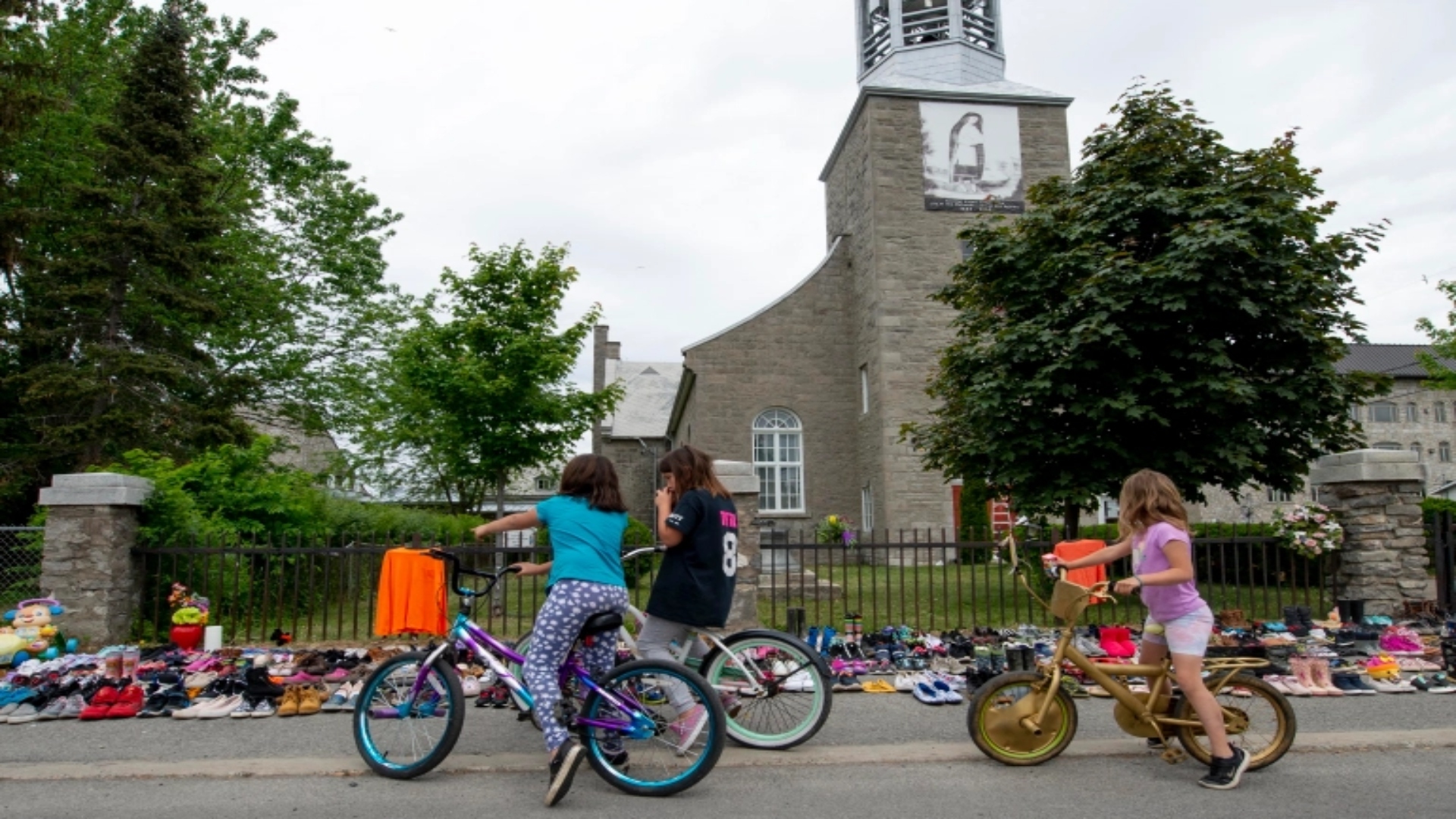
Vigils were held in major Canadian cities. Indigenous leaders called for answers from the government and the churches that ran the schools, and communities launched searches of their own. In 2022, Pope Francis came to Canada to apologise for the “evil” that had been committed at the institutions.
Yet, at the same time, the findings in Kamloops also fuelled a wave of denialism as right-wing figures pounced on limited errors in early media reports on the announcement to spread false claims.
They argued that the community had lied about excavating the 215 children’s bodies and that mainstream media outlets were promoting a false narrative to advance reconciliation.
But Tk’emlups te Secwepemc never said it had excavated any bodies. Its radar search was preliminary, and it said more work would be done. Exhumation is also not always a community’s preferred course of action, with some wanting to leave the burials undisturbed.
Still, conspiracy theorists claimed no burials existed at all, and the so-called “mass grave hoax” spread rapidly – including in a book co-written by a former adviser to ex-Conservative Prime Minister Stephen Harper.

That conspiracy theory remains one of the most prevalent forms of residential school denialism today. It also has led to real-world consequences.
In a 2023 report (PDF), Kimberly Murray, an independent special interlocutor on missing children and unmarked graves and burial sites associated with residential schools, said denialists had entered the site at Kamloops without permission.
“Some came in the middle of the night, carrying shovels; they said they wanted to ‘see for themselves’ if children are buried there,” Murray wrote.
Technology limitations, record-keeping gaps

Kisha Supernant, director of the Institute of Prairie and Indigenous Archaeology at the University of Alberta, said denialists have “preyed on the ambiguity” linked to ground-penetrating radar (GPR) technology, which was used in the Kamloops search.
“There was an impression out of Kamloops that ground-penetrating radar can find bodies; it can’t. It can find areas of disturbance. Some of those areas of disturbance are the right size, shape, depth, orientation, to be a potential grave. Others are not,” Supernant explained.
“There’s no such thing as certainty with ground penetrating radar alone because it’s not an X-ray. It’s much more like an ultrasound.”
The technology also works better in specific types of terrain, she told Al Jazeera. For example, searches in sandy soils are more successful compared with ones in gravel or clay.
“There have been times where I’ve been working in-community, and I say, ‘Well, we need to test the equipment first because it may not work in this area’,” she said. “And I’m in a cemetery where I know there are graves, and the GPR can’t see them because of the soil conditions.”

Gaps in residential school records also have made investigating deaths at residential schools more difficult – and fuelled denialism.
“There was never really a solid and consistent record-keeping system that managed the schools,” explained Raymond Frogner, the head of archives and senior director of research at the National Center for Truth and Reconciliation (NCTR).
But Frogner said it is not up for debate that deaths occurred.
Children at residential schools died from illnesses, including influenza or tuberculosis, which often ravaged the overcrowded and poorly ventilated facilities. Some died due to a lack of medical care, from neglect or injuries, or by suicide. Others disappeared after running away.
The latest figure for child deaths at residential schools is approximately 4,100, Frogner told Al Jazeera – but the research is ongoing, and the full tally is expected to be much higher.
The NCTR is also going school-by-school to try to determine “the final destiny” of the children who have gone unaccounted for. Frogner described it as a “difficult and long-term process”.
“In many cases, there is no death certificate, but there are journal entries of a lost child, or the quarterly report indicates that the child is no longer at the school. So the research we’re doing now is to track down these kinds of indications of loss,” he said.

Amidst that work, Frogner said the NCTR remains cautious about acknowledging denialism.
“Our mission is to promote an understanding and an education and a healing of these events – not to prove that they actually occurred. That should have already been an accepted fact,” he said.
That was echoed by Supernant, who has been involved in community-led searches associated with residential schools since 2018. “We’re not trying to prove children died; that’s well established,” she said.
“We’re trying to find out where they’re buried because that’s been lost over the years – and sometimes deliberately erased from the landscape.”
‘Normalisation’ of harms

While Indigenous communities have long known about deaths at residential schools and the existence of unmarked burial sites, for much of Canada’s history, the residential school system was left unscrutinised.
“Canada normalized the disappearances, deaths and unmarked burials of Indigenous children for well over a century on a scale that is indefensible,” said Murray, the special interlocutor, in her final report (PDF) last year.
Eva Jewell, the head of research at the Indigenous-led Yellowhead Institute, said the feeling of normalisation was prevalent even among residents of her community, the Chippewas of the Thames First Nation in southwestern Ontario.
Chippewas of the Thames was home to one of the country’s first residential schools, Mount Elgin Industrial School.
“It was for a long time just kind of seen as what was necessary to happen to us, in order for us to fit in with this dominant society,” she told Al Jazeera of the residential school system.
But that view began to change in the 1960s and 1970s, when former students started speaking out about their experiences with the advent of therapy, Jewell explained.
Then, in the 1990s, groups of survivors filed lawsuits against the Canadian government to demand reparations for what they had endured, culminating in the Indian Residential School Settlement Agreement of 2006.
The largest class-action settlement in Canada’s history, the agreement ushered in what Jewell describes as “the apology era”.
The Truth and Reconciliation Commission of Canada (TRC) – born out of the settlement agreement – was launched in 2007, and a year later, Prime Minister Stephen Harper apologised for residential schools in the House of Commons.
In 2015, after hearing from more than 6,500 witnesses – including survivors – over six years, the TRC said in its final report (PDF) that the residential school system “was an integral part of a conscious policy of cultural genocide”.
“Children were abused, physically and sexually, and they died in the schools in numbers that would not have been tolerated in any school system anywhere in the country, or in the world,” it said.

Just months after the TRC released its report, Justin Trudeau’s Liberal Party won federal elections on a promise to make truth and reconciliation with Indigenous people one of its top priorities.
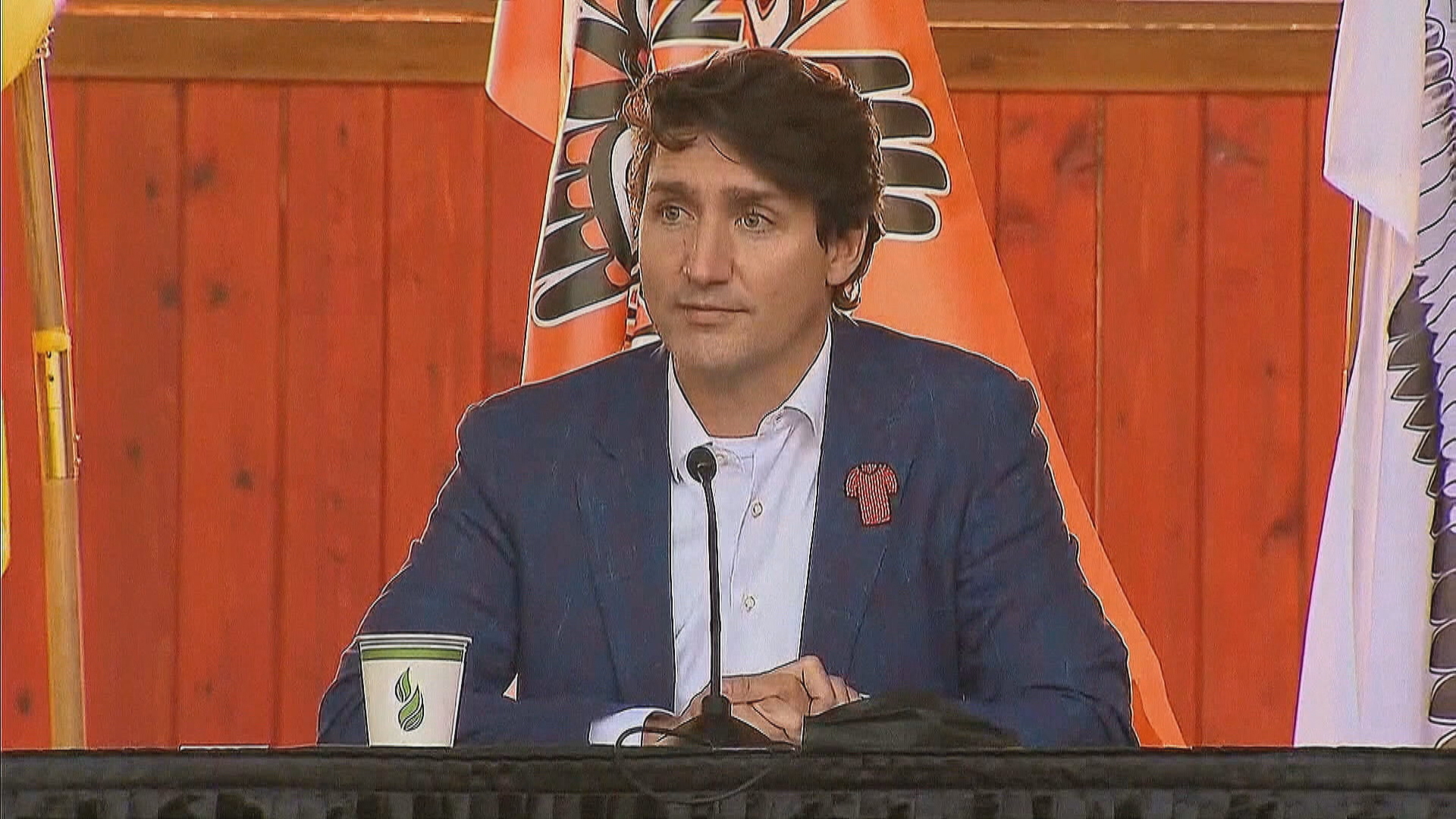
“We have to acknowledge the truth: Residential schools were a reality, a tragedy, that existed here in our country and we have to own up to it,” the prime minister said days after Tk’emlups te Secwepemc located the unmarked graves in Kamloops in 2021.
That June, amid international and domestic outcry, the Trudeau government completed three of the TRC’s “Calls to Action”, including the creation of a National Day for Truth and Reconciliation.
Yet Murray, the special interlocutor, said in her report that there has been “systemic failure to document the historical and ongoing genocide of Indigenous Peoples within Canada, including the failure to educate Canadians about this aspect of Canada’s national history”.
This “continues to create conditions where denialism can flourish”, she warned.
According to Jewell, the idea underpinning residential school denialism – “that Indigenous peoples are in the first place unworthy of being sovereign peoples” – also remains firmly embedded in the fabric of Canada.
“We actually, historically speaking, have only had a very small window of time where there was an acceptance that residential schools were a harmful practice,” she told Al Jazeera.
“Reconciliation was never strong enough … in the Canadian public consciousness for us to even be saying that denialism is on the rise. It was more like reconciliation was on the rise, and now it’s fading out,” Jewell said.
“Canadians need to remember that. Reconciliation is not who they are. Denialism is who they are.”
Global shift to the right

While residential school denialism is specific to Canada, experts say the phenomenon cannot be divorced from wider global trends. That includes the rise of far-right movements and resistance to efforts to confront the effects of colonialism.
Carmen Celestini, a lecturer at the University of Waterloo who studies far-right movements, said residential school denialism has shifted over the past year from conspiracy-theorist circles to being a prominent talking point among white Christian nationalists.
“White nationalists [are] saying that it’s a way to oppress white people and to make white people feel guilt,” Celestini told Al Jazeera.
Denialism, she added, was often an offshoot of a feeling of alienation among predominantly white men.
“When we think about this residential school denialism or the conspiracies that are attached to it … it really comes from feeling disenfranchised and not part of society or not part of politics.”
Adherents to this way of thinking also buy into the right-wing argument that “woke” actors have launched a concerted attack on “white people history”, Celestini explained.
“Their trust groups are individuals like [right-wing figures] Jordan Peterson or Joe Rogan, people online who interpret the news or world events through either a conspiracy or a bias or a hate lens,” she said.
In recent years, the United Kingdom and the United States have also seen right-wing pushback against efforts to examine their histories of colonisation and slavery, as well as the existence of systemic racism today.
“They’re all engaging in a defence of colonialism as humanitarian, benevolent. They’re engaging in racist rhetoric that blames Indigenous people, that undermines their authority,” said Carleton, the University of Manitoba professor.
“Residential school denialism needs to be understood as part of this larger global movement.”
In Canada, as awareness around residential schools has grown, conservatives have rejected efforts to take down statues or rename institutions honouring some of the figures involved in establishing the system.
That includes John A Macdonald, Canada’s first prime minister, and Egerton Ryerson, an Ontario educator who helped design the residential school policy.
Nevertheless, in 2022, Ryerson University in Toronto was renamed Toronto Metropolitan University due to public pressure.

Carleton said he expects residential school denialism to get worse in this “backlash moment”, particularly as Canada is set to elect a Conservative government later this year.
Recently, Conservative Party leader Pierre Poilievre – a populist who regularly attacks the media and his critics – hailed Macdonald as “a nation-builder” who laid “the foundation for a strong and prosperous country”.
“Without his vision, Canada would not exist today,” Poilievre wrote in a Facebook post on January 11 marking the former prime minister’s birthday.
In an interview in early January with Peterson, the right-wing commentator, Poilievre also denounced “an obsession with race that woke-ism has reinserted” and “invented in many ways”.
“We’re going to be grateful again, and we’re going to inculcate the values of gratitude for our incredible history,” Poilievre said, adding that Canada owes “a debt of gratitude to the giants who came before us”.
‘It’s hateful, it’s violent’

For Leah Gazan, any rhetoric that fails to recognise “that what happened in residential school was founded on racism, was founded on genocide [and] was founded on the violent dispossession” of Indigenous people is deeply problematic.
The Canadian lawmaker, who represents Winnipeg Centre for the left-leaning New Democratic Party (NDP), also says denialism is an attack on the ability of survivors, their families and their communities to live free from hate.
That’s why, late last year, Gazan put forward legislation that seeks to address the problem by criminalising residential school denialism in Canada.
“People should be free and protected from the incitement of hate. Denying somebody’s genocide, it’s hateful, it’s violent, and we need protection,” Gazan told Al Jazeera.

Bill C-413 would make it a criminal offence for anyone to willfully promote “hatred against Indigenous peoples by condoning, denying, downplaying or justifying the Indian residential school system in Canada or by misrepresenting facts relating to it”.
The proposed legislation is modelled on a provision recently added to Canada’s Criminal Code that makes it a crime to condone, downplay or deny the Holocaust, other than in private conversation. The provision provides a short list of exemptions.
Some right-wing media outlets have hit out against Gazan’s proposal, arguing that it would infringe upon freedom of expression.
But Kenneth Grad, a professor of law at the University of Manitoba, said “it’s very unlikely” that the bill would be declared unconstitutional.
While freedom of expression is guaranteed under the Canadian Charter of Rights and Freedoms, Grad explained that the Supreme Court of Canada “has upheld hate speech laws, specifically willful promotion of hatred, as being a justifiable limit”.
“There is an important symbolism to these provisions,” he told Al Jazeera.

However, Grad noted that the provision making Holocaust denial a criminal offence has rarely been used since it was enacted in 2022, which raises the question of just how effective these types of measures are in practice.
He added that, given the “pernicious” nature of residential school denialism, “the desire to combat it through the criminal law is natural”.
“But I do think that, as far as their practical utility, there’s reason to question how much they will actually accomplish in terms of combatting residential school denialism.”
The way forward

Still, many say that criminalising residential school denialism is a critical step if Canada is serious about protecting those most affected.
Doug George-Kanentiio is among the residential school survivors who have expressed support for Bill C-413.
A survivor of the Mohawk Institute residential school in Brantford, Ontario, he said the legislation will help give a “meaningful voice” to the children who never came home – including those whose remains are believed to be buried on the grounds of that institution.
“We’re trying hard to bring justice to those children,” George-Kanentiio said during an October news conference in support of the bill.
“When people say that [things] didn’t happen, I challenge them: Come to the Mohawk Institute. It’s still standing,” he said.
“Walk with us through the grounds, and listen to the children as they run up and down those stairs trying to escape their abusers. That’s the reality of the Mohawk Institute. You can’t hide behind these things. You have to come to grips with it.”

It remains unclear if and when Bill C-413 will be introduced for debate in Parliament.
The House of Commons is set to resume in late March, but opposition MPs are expected to quickly move to bring down the Liberal Party government and trigger an election. Polls suggest the vote will likely usher in a new Conservative administration.
“If this country is not ready to protect the truth, if this country is not ready to protect survivors, their descendants, communities and families, we’re not ready to reconcile in this country,” said Gazan, who told Al Jazeera she will keep speaking out.
Whichever party is in power, Indigenous advocates say Ottawa should take concrete action to push back against residential school denialism, including by investing in education.
“There is this education gap that denialists are preying on and there’s not a lot of movement in terms of bringing people into the conversation to learn the truth,” said Carleton, the professor. “That’s sort of where we’re stuck.”
The government also needs to provide long-term funding for Indigenous communities seeking to investigate deaths and unmarked burial sites linked to residential schools, according to Supernant.
She said that since the Kamloops announcement in 2021, there has been a 10-fold increase in community interest in conducting searches, but many of the funding agreements are ending this year or in 2026.

“I worry … that without that support and without that resourcing, communities aren’t going to get what they need, and it’s just going to continue to do harm. And that’s a very real possibility right now,” Supernant said.
And for survivors like Geraldine Shingoose, there is no time to waste in confronting denialism.
“As a survivor, I’m out there sharing my story. I’ve shared my story probably with over 25,000 individuals in schools, universities and organisations,” she told Al Jazeera.
“But you know, we’re not going to be here [much] longer to share our stories. We need people to listen to us.”
Joint Statement on Indian Residential School Denialism by the CAA, the Society for American Archaeology (SAA), the Canadian Association for Biological Anthropology (CABA-ACAB), and the Canadian Permafrost Association (CPA)
Content Warning: This statement deals with child death and Indian Residential Schools
If you are experiencing trauma or feeling triggered, help is available 24/7 for survivors and their families through the Indian Residential Schools Crisis Line at 1-866-925-4419. Mental health support for Indigenous peoples in the lands known as Canada is available through the Hope for Wellness chatline at 1-800-721-0066 or using the chat box at https://www.hopeforwellness.ca/. The Indian Residential Schools Survivors Society provides information about these and other supports that are available: https://www.irsss.ca
The CAA, SAA, CABA-ACAB and CPA are deeply concerned about the increasing frequency of residential school denialism in mainstream media. The one-year anniversary of Tk’emlúps te Secwépemc First Nation’s announcement identifying unmarked graves at the former Kamloops Indian Residential School (IRS) in British Columbia prompted a National Post article criticizing the initial reporting on the findings and calling into question additional findings of potential unmarked graves at residential schools and a New York Post article framing them as fake news. Such denialist accounts attempt to downplay the impacts of residential schools and the tragic events that happened to the children who attended them. They are built on flawed logic, as detailed by Daniel Heath Justice and Sean Carleton here and by Kisha Supernant here.
In the year since Tk’emlúps te Secwépemc First Nation’s announcement investigators have identified hundreds of additional potential burials at multiple former IRS sites. Denialist arguments call into question the legitimacy of these investigations. The fact that children died or went missing from schools is indisputable. It is supported by the findings of the Truth and Reconciliation Commission (TRC) of Canada, which compiled first-hand knowledge by survivors, extensive archival sources, and employee accounts, among many other lines of evidence.
The location of children who went missing or died at residential schools is often unknown. Families were often not informed of deaths and disappearances, records were not always kept, existing records are not always shared, markers that may have been placed have long since disappeared. For communities wanting to find their missing children, ground penetrating radar (GPR) and other near-surface geophysics and remote sensing techniques can help them locate potential graves in the absence of clear indications of where children were buried.
Disturbingly, some of the denialist arguments point out that to date none of the missing children investigations have located human remains, implying that such discoveries are the only way to “prove” that graves are present. This is profoundly disrespectful to Indigenous communities experiencing the intergenerational trauma inflicted by these schools. While it is true that we can never be 100% certain about the cause of an anomaly without excavation, it is also true that the nature of individual anomalies, and patterns of multiple similar anomalies within a given area can in some cases reduce the uncertainty to almost zero. In other words, in some cases GPR can demonstrate the presence of graves beyond a reasonable doubt, especially when coupled with additional evidence from archives or oral testimony. No one has the right to demand that Indigenous communities excavate potential graves to “prove” the demonstrated fact that there are missing children who died at residential schools. Only Indigenous communities can decide their path forward to healing.
Residential school denialism undermines the tragic loss of innocent Indigenous children. It attempts to mask the horrors that took place at these schools and derail the growing movement by governments and the broader public to redress these harms and their ongoing impact on Indigenous peoples in Canada today. It denies the truth and works against reconciliation.
The CAA, SAA, CABA-ACAB and CPA call out the misrepresentations and false claims of denialists and strongly supports Indigenous communities’ rights to decide whether and how to search for their missing children, and how to commemorate and memorialize them. We support Indigenous leaders’ calls for access to all remaining residential school records and call upon all levels of government to continue to support communities as they walk this difficult path. The CAA will continue to develop resources to help Indigenous communities make informed decisions and training materials to help them build capacity to conduct their own investigations.
Canadian Archaeological Association Board of Directors
Deborah Nichols, SAA President
CABA-ACAB Standing Committee on Residential School Graves
CPA Board of Directors
,,,
https://news.umanitoba.ca/tag/debunking-residential-school-denialism/
debunking residential school denialism News Archive
Faculty of Arts
CBC British Columbia: Tk’emlúps te Secwépemc says ‘215’ search for truth continues
May 27, 2024 —
Tk’emlúps te Secwépemc says ‘215’ search for truth continues
Faculty of Arts
CBC B.C.: Calls for Quesnel mayor to step down
April 5, 2024 —
CBC B.C.: Calls for Quesnel mayor to step down
Faculty of Arts
Conversation Canada: Fact-checking residential school denialists and debunking ‘mass grave hoax’
October 17, 2023 —
What did Canadian news outlets actually report after the Tk’emlúps te Secwépemc First Nation made their public announcements about their search for missing children? Two UM experts fact-check residential school denialists and a ‘mass grave hoax’ theory
,,,,,
https://www.ictinc.ca/blog/handling-tough-questions-about-denialism
There isn’t a single public school in Canada or in the United States that features a graveyard out back next to the football field. [1]
Grand Chief Stewart Phillip, president, Union of BC Indian Chiefs
My personal and professional goal has always been to “change the world, one person at a time.” When I initially began delivering Indigenous awareness training for a large utility company in my home province of BC in the late 1990s, I was up against a certain level of intolerance towards Indigenous Peoples that was the norm for the era. While visiting some towns to deliver a training session, my sense of vulnerability was acute. I represented change to the status quo coming down the pike. I persevered, and after a few rough sessions, I noticed a shift in attitude.
I have always taken great pains to deliver training without guilt or shame to the learners. I wasn’t there to make people uncomfortable with history. I was there to present facts and a perspective they may not have encountered or considered, as well as practical tips and insight on developing effective, respectful and sustainable relationships with Indigenous communities and individuals. I launched my own company, Indigenous Corporate Training Inc., in 2002 and was soon asked to train all over the province, across Canada and beyond our borders. I found the growth in demand for Indigenous relations training heartening as a business owner and as a Canadian.
Change was happening, but it was from the top down. Corporations and organizations, particularly in the resource extraction sector, realized that positive working relationships with the Indigenous Peoples impacted by their projects were good for their bottom line.
And then, in 2015, the Truth and Reconciliation Commission of Canada published its reports and 94 calls to action for reconciliation. The reports brought to light the atrocities 150,000 Indigenous students endured at the 139 church-run, federal government-funded residential schools between the late 1880s and 1997. An estimated 6,000 children died or disappeared from those schools. For many Canadians, the existence and conditions of residential schools came as a complete shock.
Thousands of Indigenous children were subjected to violence, abuse, disease, and neglect in these institutions, and many of them died. Their death rates were far higher than those of non-Indigenous school-aged children. When they died, government and church officials often did not return the children to their families and communities for burial. They were buried instead in cemeteries at the institutions, often in unmarked and mass graves that were sometimes dug by other children. Many of these cemeteries and burial sites are neglected, abandoned, and unprotected. Families were provided with little information about what happened to their children. [2]
The National Centre for Truth and Reconciliation and the Truth and Reconciliation Commission have so far documented 4,117 deaths of First Nations, Inuit and Métis children in residential schools across Canada. Identifying the children is a slow process due to inaccurate record-keeping by the schools and the government.
- The Indian Act, Residential Schools and Tuberculosis Cover-Up
- A Brief Look at Indian Hospitals in Canada
Following the publication of the Truth and Reconciliation Reports, Canadians took the calls to action to heart. We began to see land acknowledgements (in some Indigenous cultures, territorial acknowledgement is known as protocol) at meetings, sports events, film festivals, on websites, and in email signature blocks. We saw curriculum changes in grade school and post-secondary institutions. We saw the Declaration on the Rights of Indigenous Peoples Act (DRIPA) receive Royal Assent under the federal Liberal government. In BC, we saw the provincial government under the NDP unanimously pass the Declaration on the Rights of Indigenous Peoples Act (Declaration Act). Every September, the country is awash with people of all ages wearing orange t-shirts. In 2021, the federal government declared a new statutory holiday on September 30 to mark the National Day for Truth and Reconciliation.
Change was happening, but now it was driven from the grassroots level. Individuals, mom-and-pop shops, not-for-profit organizations, churches, and families were having difficult conversations and looking at what they could do to support reconciliation.
Then Tk’emlúps te Secwépemc, in 2021, announced that ground penetrating radar (GPR) had detected anomalies suspected to be graves on the grounds of Kamloops Indian Residential School.
Elders and Survivors have always spoken of children dying and disappearing while at the school. Men speak of, as boys attending Kamloops Indian Residential School, being woken in the middle of the night, and asked to dig holes that seemed like graves, in the dark, and not being told why. [3]
Tk’emlups te Secwépemc Kúkpi7 (Chief) Rosanne Casimir
The news shocked Canadians and made international headlines. Since then, the grounds of many residential schools have been tested with GPR. Each time the gut-wrenching results are announced, there is an outpouring of support for the communities, the survivors, and their families.
But there has also been an outpouring of anger and denialism. The rise of denialism and its impact on residential school survivors and the erosion of progress with reconciliation since then is of such concern that in 2024, an NDP MP introduced a private member’s bill to add residential school denialism to the Criminal Code. If Bill C-413 is passed, anyone convicted of “wilfully promoting hatred against Indigenous peoples by condoning, denying, downplaying or justifying the Indian residential school system in Canada through statements communicated other than in private conversation” [4] could face up to two years in jail.
Hand in hand with denialism is resentment of government funding for communities to conduct the GPR testing to find the missing children.
Finally, the Indigenous file reaped even more rewards, including $91 million for communities to “document, locate and memorialize burial sites at former residential schools” — which some contend, erroneously, to be evidence of genocide. Another $5 million has been set aside to combat “residential school denialism,” which the Liberals contemplated criminalizing last year. [5]
The National Post, April 18, 2024
The increasing presence of denialism, hatred and resentment in discourse is concerning. It feels as if Canada is in danger of sliding backwards on the progress made in reconciliation and Indigenous relations. However, I don’t think putting people in jail is the answer. Nor does my father, Chief Robert Joseph, a residential school survivor.
In this interview, “Dealing with Residential School Denialism,” on CBC radio, the interviewer asked my father if he agreed with jail time for residential school denialism. He responded that if you lock someone up, you are never going to bring them on board, and you are sending them the message that they are hopeless (paraphrased). I am sure many listeners were surprised by his answer.
I agree with my father’s wise words but want to expand on how dialogue fosters understanding. One of the training skills I was taught and shared with all our trainers was to thank everyone for all questions, whatever their nature, and to treat the question and the asker with respect.
Questions are the portal to dialogue, and it is through dialogue that we can share knowledge and different perspectives and learn from one another. But for that to happen, people have to feel safe asking their questions. As facilitators, we are adept at answering awkward questions. We answer to the group rather than focusing on the person who asked the question.
Our trainers have all experienced profound group discussions arising from a single awkward question, be it about denialism or one of the many myths about Indigenous Peoples. We know we may not lead the person to accept a different perspective, but we know the greater group has benefitted from the dialogue.
Awkward comments and questions about Indigenous Peoples often arise in social settings. How should you, a supporter of reconciliation, respond? Here are two articles with some insight and tips to help you navigate these situations safely.
As Canada continues its journey along the reconciliation path, there will be setbacks, but we can’t let them push us off course. Like my father, I believe we can all learn to live harmoniously together while respecting our diversity.
When I published 21 Things You May Not Know About the Indian Act in 2018, the response was astounding. It quickly became a national bestseller and was listed as one of the top 20 books of that decade. Sales of the book continue to outperform expectations. It may seem like I am tooting my own horn here, but I am not. I am expressing gratitude to all those Canadians who want to learn about the past so they can help shape the future.
I dedicated the book to Canada and reconciliation. I used this quote from Canada’s former Governor General Michaëlle Jean at the relaunch of the Truth and Reconciliation Commission of Canada in 2009.
When the present does not recognize the wrongs of the past, the future takes its revenge. For that reason, we must never, never turn away from the opportunity of confronting history together – the opportunity to right a historical wrong.
To me, this quote puts into perspective the bigger picture of reconciliation’s importance.
By Bob Joseph, Co-Founder & President
[1] ‘Deeply disturbing’: 3rd anniversary of 215 suspected unmarked graves found in Kamloops, CityNews Everywhere, May 27, 2024
[2] As quoted in Sites of Truth, Sites of ConscienceUnmarked Burials and Mass Graves of Missing and Disappeared Indigenous Children in Canada, Office of the Independent Special Interlocutor for Missing Children and Unmarked Graves and Burial Sites associated with Indian Residential Schools, 2024, p 7
[3] ‘Deeply disturbing’: 3rd anniversary of 215 suspected unmarked graves found in Kamloops, CityNews Everywhere, May 27, 2024
[4] Bill C-413 An Act to amend the Criminal Code (promotion of hatred against Indigenous peoples) openpaliarment.ca
[5] Liberals, again, use federal budget to advance demographic favoritism, National Post, Apr 18, 2024
Featured photo: Jason Woodhead, Flickr.
,,,
Truth Before Reconciliation: Confronting Residential School Denialism in Canada
Truth Before Reconciliation: Confronting Residential School Denialism in Canada
Across this country, residential school denialism is not new. It is part of Canada’s long history of refusing to confront colonial violence. While voices like Aaron Gunn have brought it into sharper public focus, this form of denial has always existed. It is not only about denying the past. It is about repeating it.
Let’s be clear: denialism is not just disagreement. It’s harm.
It silences Survivors.
It erases the lives of thousands of Indigenous children who never made it home.
And it reinforces the same systems that created the residential school system in the first place. Systems rooted in white supremacy, control, and erasure.
The Truth and Reconciliation Commission of Canada (TRC) documented the horrific experiences of Indigenous children who were taken from their families, stripped of their cultures, abused, and in many cases, never seen again. This is not speculative. It is not up for debate. It is truth shared courageously by Survivors and families who continue to carry the weight of intergenerational trauma.
Denialism is not new. For over a century, residential schools were framed as “benevolent” institutions meant to civilize and educate. In reality, they were sites of cultural genocide, designed to sever Indigenous Peoples from their identities, families, languages, and Nations. The erasure we are seeing today is not a sudden resurgence. It is a continuation of a long pattern where Indigenous truths are questioned, invalidated, and buried.

And that pattern is not just playing out on fringe YouTube channels. It is being echoed at the highest levels of Canadian politics. Conservative Party leader Pierre Poilievre has continued to support Aaron Gunn, even after Gunn released a video denying the reality of unmarked graves and challenging the findings of the TRC. This is not just irresponsible. It is a deliberate alignment with denialism. It shows us exactly how comfortable some political leaders are with erasing Indigenous truths if it serves their narrative or consolidates their base.
As a non-Indigenous person, I know it is not my place to speak over Indigenous communities or claim to understand the full weight of this violence. But I also know that silence serves the status quo. That when denialism spreads unchecked, it creates space for more harm. My role, as a settler on these lands, is to listen, to learn, and to speak out where I can.
Even among settlers who support reconciliation in principle, there is often an unspoken hope that we can move on. That wearing an orange shirt, reading a land acknowledgement, or posting a hashtag is enough. But truth is not a checkbox. It is a commitment. And that commitment must include challenging denialism wherever it shows up, on YouTube, in political platforms, in classrooms, and in our own families.
Canada cannot move forward while refusing to look back. We cannot talk about healing while Survivors are still fighting to be believed. And we cannot talk about reconciliation while politicians and content creators deny the basic facts of this country’s history.
Reconciliation without truth is just another form of denial.
And truth, real truth, is not easy.
It demands that we sit with discomfort, not run from it.
It asks us to see how we are connected. Not just to the land we live on, but to the systems we benefit from.
And it calls on us to show up again and again with humility, courage, and care.
So if you’re reading this and wondering what you can do, start here:
- Believe Survivors. Read their testimonies. Share their voices.
- Speak up when denialism is disguised as “just asking questions.”
- Challenge the people in your circles who minimize the violence.
- Support Indigenous-led organizations, education, and land back movements.
- Reflect on what it means to be a guest and what kind of guest you want to be.
Because the truth is not optional.
And if reconciliation is going to mean anything, it has to start with telling the truth.
How Museums Can Respond to Residential School Denialism
Updated: October 12, 2023
Content Warning: This post contains content about Residential Schools, denialism, and genocide.
A note on safety, self-care, and self-regulation. The content covered in this post can be triggering and upsetting. As you read and think about this information, try to pay attention to your body’s cues that you might need to come back to this topic another time. Your well-being is important.
If you are an Indian Residential School survivor or have been affected by the residential school system and need help, you can contact the 24-hour Indian Residential Schools Crisis Line: 1-866-925-4419
Museums, and all arts, culture, and heritage spaces, have a critical role to play in confronting residential school denialism.
This post is the first of a series of resources the BC Museums Association is developing to support our sector in being prepared to address residential school denialism in all forms – from online comments, to in-person questions, to internal misinformation.
In response to Tk’emlúps te Secwe̓pemc’s announcement of the location of 215 potential unmarked graves at the former Kamloops Indian Residential School in 2021, there has been a renewed effort to subvert, manipulate, or outright deny the role of residential schools in the genocide of Indigenous peoples in the lands now known as Canada. Like other forms of mis- and disinformation, residential school denialists seek to undermine society’s understanding of the truth in order to further their own destructive political and social beliefs.
As Dr. Niigaan Sinclair and Dr. Sean Carleton state in their op-ed Residential School Denialism Is on the Rise. What to Know, “Denialism is a barrier to reconciliation… The TRC was clear that reconciliation is not an Indigenous burden but a Canadian responsibility — and an opportunity to build stronger relations with Indigenous peoples.” Non-Indigenous Canadians have a responsibility to confront denialism and as heritage and museum professionals, we have the power to inform public conversations about the past, giving us an obligation to take action.
What is Residential School Denialism?
Residential school denialism, like other forms of genocide denial, can take many forms. Regarding Holocaust denial, the Auschwitz-Birkenau Memorial and Museum writes, “The denial of the Holocaust and genocide take many forms, from simply ignoring obvious facts by manipulating the sources, through minimizing the dimensions of genocide, to trivializing and rationalizing genocide by analogy and claiming that it is an acceptable example of the kinds of things that happen in wartime.”
Definition
Residential school denialism is defined by scholars Dr. Daniel Heath Justice and Dr. Sean Carleton as “the rejection or misrepresentation of basic facts about residential schooling to undermine truth and reconciliation efforts… in ways that ultimately protect the status quo as well as guilty parties.” (The Walrus)
Similarly, residential school denialism is a spectrum that ranges from minimizing, to doubt, to outright denial. Denialist talking points or misinformation can insidiously influence people who would not identify as a “residential school denier.” For this reason, it can be difficult to quantify the number of deniers in Canada. Since the closing of the Truth and Reconciliation Commission of Canada in 2015, and more recently in response to increasing public discussions about the destruction caused by residential schools, deniers have been more vocal. Many have spoken up in recent opposition to, and impatience for, the ongoing work of Indigenous communities, the Ministry of Indigenous Relations and Reconciliation, and other involved parties completing research work in relation to residential school gravesites.
It is similarly challenging to definitively describe the forms denialism can take. Dr. Justice and Dr. Carleton have written a good resource offering strategies for identifying and confronting denialism. The article cites the 2015 final report of the Truth and Reconciliation Commission, stating “too many Canadians know little or nothing about the deep historical roots’ of the ongoing issues stemming from settler colonialism generally and residential schooling specifically.” This lack of historical knowledge, combined with the positive images that the church and government have for many Canadians, can often lead to the “positive” framing of residential schools.
As Dr. Justice and Dr. Carleton argue, denialism is not exclusively the outright denial of the existence of residential schools, but rather “the rejection or misrepresentation of basic facts about residential schools.” This can take the form of rhetoric tricks like hyper-focusing on narrow definitions of genocide to contest the idea that genocide is applicable to Canada, drawing false comparisons between boarding schools or orphanages and residential schools, focusing on the “new skills” and “education” offered by residential schools, accusing their opponents of ignoring “all the good things” associated with the schools, suggesting that historians must offer a “balanced” or “apolitical” assessment of residential schools, or attempting to justify residential schools by saying such actions were normal “for the times.” Each of these tactics attempts to subvert the truth and rewrite history to make it more favourable to settler colonialism.
About the Special Interlocutor’s Interim Report
Unmarked gravesites have reignited national awareness of the destruction caused by residential schools and therefore have been a target for denialists. To support Indigenous communities and the government in the work to identify, research and protect unmarked gravesites, the Federal Justice Minister appointed Kimberly Murray as Special Interlocutor in June 2022. Murray’s role is to identify barriers to the work, the legal changes needed and to make recommendations for a new federal legal framework to ensure the respectful and culturally appropriate treatment of unmarked graves and burial sites of children associated with former residential schools (Office of the Special Interlocutor). Her June 2023 Interim Report includes findings on the increase of residential school denialism in Canada and offers recommendations for addressing denialism, including a significant increase in public education.
In the Special Interlocutors interim report, two community assessments of communications and reactions from the public stand out and are relevant to discussions of the damage of denialism: Tk’emlúps te Secwépemc and Cowessess First Nation. The report noted that in both communities, information was leaked to the media before a communications plan could be developed and this led to miscommunications in the media that fueled denialism and pain among the communities.
At Tk’emlúps te Secwépemc “Denialists entered the site without permission. Some came in the middle of the night, carrying shovels; they said they wanted to ‘see for themselves’ if children are buried there. Denialists also attacked the community on social media. Kúkpi7 Casimir explained that the hate and racism was so intense that she no longer uses social media without heavy filters. She said that the toxicity of denialism on social media needs more attention.” (OSI Interim Report, pg 98)
Similarly at Cowessess First Nation, Barbara Lavallee, Survivor and Lead Researcher, said that “whenever news about unmarked burials at Indian Residential School sites appear in the media, including relating to Cowessess, communities have been targeted by denialists. She said that her community has learned that the best response to denialism is no response at all.” (OSI Interim Report, pg 100)
Gravesites being found at former residential school locations often fall between conflicting legal protections offered by various levels of government, often due to a lack of existing or accessible records, property sales, and other challenges. In some cases, private security has had to be hired to protect gravesites that are currently being worked in. The fact that residential school gravesites have been visited with the intention to disturb the ground by residential school deniers seeking “the truth” is deeply troubling. Not only is it disrespectful of the cemetery and the ongoing processes of community healing and truth-telling, but it also denies Indigenous people their right to self-determination and the revitalization of Indigenous law, not to mention the basic right to be free of discrimination.
Findings to date on the increase in the violence of denialism
- Denialism is a uniquely non-Indigenous problem; it therefore requires non-Indigenous people to actively work to counter denialism and to create and implement strategies to do so.
- Broad public support for Survivors, families, and communities conducting search and recovery work can be strengthened through public education about the history and ongoing legacy of Indian Residential Schools in Canada.
- Urgent consideration should be given to legal mechanisms to address denialism, including the implementation of both civil and criminal sanctions.
- Consistent with Article 15 of the Declaration, Canada has an obligation to combat denialism and ensure that education and public information reflects the truth about missing children and unmarked burials. This is important to ensure non-repetition in accordance with the UN’s ‘Basic Principles and Guidelines on the Right to a Remedy and Reparation for Victims of Gross Violations of International Human Rights Law and Serious Violations of International Humanitarian Law.’ (OSI Interim Report, pg 188)
This report reflects a theme expressed by Dr. Sinclair and Dr. Carleton in their recent publication; that all Canadians have a role to play in standing up to the rising tide of denialism. Indigenous communities from coast-to-coast-to-coast have spent decades telling the truth in courtrooms, in Truth and Reconciliation Commission testimonies, in community documentation, and within their families. They are working to heal and find answers. Combatting residential school denialism is our responsibility as settler Canadians, as heritage workers, and as members of the broader community.
What you can do
Indigenous communities and advocates agree that responding to denialism is the responsibility of all Canadians. Everyone from museum volunteers, to public-facing staff, to managers/boards have tangible actions they can take to address and reject residential school denialism. Here are a few initial steps that arts, culture, and heritage workers/volunteers can take:
1
Familiarize yourself with common misrepresentations that residential school deniers use to spread misinformation and prepare yourself with the evidence that supports the truth.
We recommend the following introductory resources:
2
Support Indigenous staff, volunteers, and community members.
It is critical that Indigenous staff, volunteers, and community members are supported in every step of this process and to avoid making assumptions about what support looks like. This involves consulting staff/volunteers/community members about what level of involvement they would like in the development of policies and programs that address residential schools and residential school denialism. Steps can include establishing internal policies for who is responsible for addressing denialism from patrons and community members and who is responsible for responding if these comments escalate, creating protocols for how Indigenous staff/volunteers/community members are supported if they face traumatic experiences in your organization, and creating systems of accountability so that everyone in your organization feels equipped to respond effectively. All of these steps require care, time, and ongoing dialogue and may be complex or uncomfortable. Creating accountable spaces for your volunteers/staff/community members is an investment and cannot be rushed. We recommend the following resources and programs as good starting points for reflecting on how to create supportive and accountable spaces:
3
Assess how your organization tells the story of local history.
Does your organization address residential schools in its collections, programs, or exhibits? Do your staff and volunteers know what residential school sites and gravesites are in your area and if they are under active investigation? Have you trained public-facing staff and volunteers on how to address the history of residential schools and colonization? Are your board members able to speak about these topics? You can play a role in helping to educate the community about the history of the residential schools of your region.
4
Audit the language you use when discussing residential schools.
Be mindful of the language you use when discussing sensitive topics, including residential school gravesites. Terms like ‘mass grave’ are targets for denialists to attack in their quest to create skepticism and mistrust of communities and undermine the process of reconciliation.
5
Review your codes of conduct for volunteers, board members, and staff to ensure that denialist sentiment is outlined as unacceptable with clear consequences.
Please note – if you or your organization are a member of the BC Museums Association, you have already agreed to a code of conduct that “[supports] the goals set out by the Truth and Reconciliation Commission and the United Nations Declaration on the Rights of Indigenous Peoples (UNDRIP)…[and] encourages members to embrace the ideals of the Rod Naknakim Declaration and incorporate them into their professional practices.”
CMA’s recent Moved to Action report offers resources to reassess governance and HR policies to better align with UNDRIP.
6
Understand the processes being undertaken to investigate gravesites.
Reading the Interlocutors Interim Report and understanding how the provincial government is assisting communities can lead to helpful discussions about this process with others.
Keep in mind that well-intentioned discussions with persons firmly rooted in denialism will not likely change their minds, and you need to take care of yourself and your colleagues both mentally and physically. Instigating a debate can escalate into defensiveness or aggression, and your personal safety is a priority.
If you have feedback about this article or would like BCMA to develop specific resources, policies, or training materials to support effective responses to residential school denialism, please email us.
Thank you to the BCMA Indigenous Advisory Committee for their feedback and trust in the development of this article!
“Residential School Denialism and How to Counteract it” – Fifth Presentation in the “Reconciliation Through Education” Series
“RECONCILIATION THROUGH EDUCATION”
Lieutenant-Governor of Manitoba and the National Centre for Truth and Reconciliation welcome the fall session of a seven-part free public speakers’ series at Government House
Lt.-Gov. Anita R. Neville is pleased to welcome back the fall session of Reconciliation Through Education. This initiative is in partnership with the National Centre for Truth and Reconciliation (NCTR) and is designed to provide Manitobans the opportunity to learn about the truth of our history from First Nations, Métis and Inuit knowledge keepers. Presenters will share experience and insight on how all we can all play a role in the ongoing work of truth, reconciliation and healing to build a more respectful and just society for all.
“Residential School Denialism and How to Counteract it” will be the focus of the fifth presentation in the “Reconciliation Through Education” series. The series will be held on Thursday, Sept. 19 and will feature Dr. Sean Carleton, professor of Indigenous studies at the University of Manitoba.
Those wishing to attend MUST register in advance with the Office of the Lieutenant Governor by calling 204-945-2753. Seating is limited. Guests may reserve a maximum of two seats per registration. There is no cost to attend.
Doors will open at 6:30 p.m. Program begins at 7 p.m. at Government House, 10 Kennedy St., Winnipeg. Parking is available on both sides of the driveway. Light refreshments to follow.
Please consider bringing a non-perishable food item for the Lieutenant Governor’s Sharing Hope Initiative.
Presentations will be livestreamed (registration is not necessary to view the livestream) and permanently available through our website: www.manitobalg.ca.
https://www.thetyee.ca/Opinion/2025/04/22/Who-Benefits-Residential-School-Denialism/
 SHARE: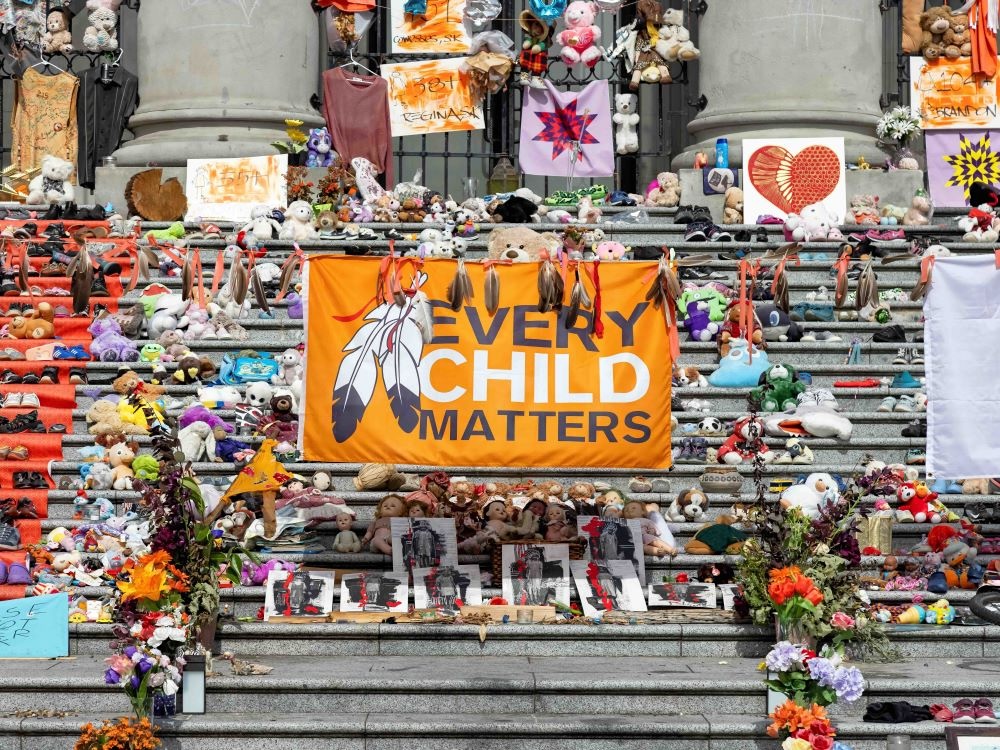
A memorial display for residential school survivors on the steps of the Vancouver Art Gallery, August 2021. Photo by EB Adventure Photography via Shutterstock.
Defending Indigenous land rights is not just a matter of justice, argues Naomi Klein in This Changes Everything. It may be “the last line of defence” against a juggernaut doubling down on a high-carbon economy regardless of the costs, including the possible collapse of organized human society.
Extractivist and climate-threatening projects, like the Coastal GasLink pipeline, are sometimes driven through the territories of Indigenous Peoples without their prior and informed consent.
So it’s no surprise that those who favour expanding fossil fuel and resource extraction-based development would be drawn to viewpoints — “elective affinity,” sociologist Max Weber called it — that limit or delegitimize Indigenous claims to land or self-determination.
One weapon for doing so is residential school denialism. It’s an ideological project born of colonialism. It doesn’t deny the existence of the residential school system but rather downplays, excuses or misrepresents facts about the harms it caused.
Professors Sean Carleton and Daniel Heath Justice outline the many ways residential school denialism distorts history.
Residential school denialism narrowly defines the term “genocide” as ethnic cleansing like the Holocaust, thus excluding the deliberate erasure of cultures as a form of genocide applicable to Canada.
It underplays the nightmarish distinctiveness of residential “schools” as prisons, where legally kidnapped youngsters obtained little effective academic or vocational instruction, and were often abused.
Denialism asserts the “good intentions” of some administrators, constructs a false balance between “good” and “bad” elements of the system and focuses on a minority of individual positive recollections from the schools.
Like deniers of the Nazi Holocaust, residential school denialism seizes upon and exaggerates data ambiguities — like precise body counts of victims — that are inevitable in any complex historical process, particularly those deliberately shrouded in secrecy.
It’s a strategy to discredit the overwhelming historical evidence and survivor testimony, particularly through the Truth and Reconciliation Commission, of the genocidal nature of the schools.
Residential school denialism has reared its head in major party politics. In my home riding of North Island-Powell River, the federal Conservative candidate, Aaron Gunn, has been called out by First Nations leaders and many others for his dismissive views on residential schools. Is it a coincidence that his financial backers have included oil tycoons?
A local grassroots campaign called on the Conservative party leadership to “drop the Gunn” as their candidate and, if he remains on the ballot, encouraged progressive voters to strategically vote NDP as the most realistic option for defeating him in this riding.
‘This wasn’t about finding truth. It was about exerting power’
Last summer, I attended a lecture in my hometown, Powell River, by an individual denialist associated with the controversial book Grave Error. (That event was reported in The Tyee.)
In my view, the speaker misrepresented the core purpose of residential schools, used ambiguities about the evidence of graves at the Kamloops Indian Residential School site to downplay the extent of children’s deaths in the system, trivialized the cultural value of preserving Indigenous languages, dissed the international phonetic alphabet as a guide for pronouncing Indigenous names and, for added measure, apparently denied the existence of trans people who do not fit into one of two genders.
The highly partisan audience frothed and applauded. Several declared their intention to run for council. This wasn’t about finding truth. It was about exerting power.
Given how the spread of residential school denialism retraumatizes survivors, Winnipeg MP Leah Gazan last year introduced a private member’s bill in Parliament proposing that it be criminalized, as Holocaust denial already is.
I’m not convinced we need to outlaw residential school denialism, but people and organizations have the right to decide not to spread it.
Regrettably, Powell River’s largest neighbourhood association, the Westview Ratepayers Society, used its newsletter to announce the local event. To be fair, it withdrew a previous, more fulsome announcement, did not mention the topic and ran a disclaimer that it wasn’t sponsoring the event. There are indications that its policy will be reviewed in the future.
More encouragingly, last fall, the city council endorsed a statement from the Union of BC Indian Chiefs condemning residential school denialism and asking municipal governments to challenge it.
And recently, the Powell River Peak newspaper declined to advertise a return event by the same speaker I heard last year.
That triggered an avalanche of flak. It included a scolding by National Post columnist Conrad Black, a convicted felon who was once described by Bob Rae, before he became Ontario’s first NDP premier, as “a symbol of bloated capitalism at its worst.”
My colleagues on the board of the qathet Climate Alliance pledged not to use our own communication outlets “to disseminate hate speech or to publicize events by speakers who have a track record of promoting disinformation or contempt towards other individuals or groups in the community, one that includes our neighbours in Tla’amin Nation.”
Our statement specifically mentions both Holocaust denialism and residential school denialism, both complicit in whitewashing genocide.
We don’t need a U.S. hedge fund-owned newspaper chain, or an addition to criminal law, to connect the ideological dots between extractivism and denialism.
Or to take action in our own communities to counteract their spread. ![[Tyee]](https://www.thetyee.ca/design-article.thetyee.ca/ui/img/yellowblob.png)
Read more: Indigenous, Rights + Justice, Election 2025
Exposing Residential School Denialism’s Transnational Network
Exposing Residential School Denialism’s Transnational Network
By Sean Carleton, Alan Lester, Adele Perry, and Omeasoo Wahpasiw
Residential school denialism is on the rise in Canada and meaningful reconciliation is at risk.1 After the release of the Truth and Reconciliation Commission’s Final Report in 2015, and especially since the Tk’emlúps te Secwe?pemc Nation’s 2021 announcement about the location of potential unmarked graves at the former Kamloops Indian Residential School and the confirmation of additional deaths at other schools across the country, many priests, pundits, and politicians across the country have engaged in what is known as residential school denialism.2
Denialists do not usually deny the residential school system’s existence, or even that it did damage. Rather, like in other cases of denialism, they employ a discourse that twists, distorts, and misrepresents basic facts about residential schooling to shake public confidence in truth and reconciliation efforts, defend guilty and culpable parties, and protect Canada’s colonial status quo.
Denialism spikes at predictable times, such as the anniversary of the Kamloops announcement (May 27) and Orange Shirt Day (marked in Canada on September 30 as the National Day for Truth and Reconciliation). Indeed, in the period leading up to and just following September 30, 2024, there were a number of concerning incidents of denialism – from the usual far-right publications promoting the “positives” of the genocidal IRS system to the spreading of conspiracy theories and disinformation by politicians and social influencers.3
In response, a number of Indigenous writers have pointed out the harms that denialism causes and stressed the need for settler Canadians to confront this dangerous phenomenon if Canada is serious about its commitment to truth and reconciliation.4
What is getting less attention, however, is residential school denialism’s global spread. Residential school denialism may have its origins in Canada, but it is increasingly circulating and being used around the world as part of a wider matrix of imperial apologetics – a transnational network of discourse that aims to defend the legacy of the British Empire in the metropole and former colonies.5

Circuits of Empire
To better understand denialism’s transnational nature, it is important first to contextualize this phenomenon as a continuation of the imperial project itself. As historians have demonstrated in recent decades, raw resources during the age of empire were often extracted from colonies and shipped back to the metropole to be manufactured, consumed, and sold on the global market through transimpeiral networks for profit. This multidirectional circuit of draining wealth from the colonies and consolidating imperial power – often legitimized discursively by insisting on the benevolent and even humanitarian intentions of empire – was a cornerstone of European empires.6 Today, the old circuits of empire are being repurposed in bitterly contested culture wars. Imperial apologists are drawing on denialism created in former colonies to redeem the empire, protect its spoils, and weaponize imperial heritage as a political tool today.7
In this context, residential school denialism in Canada has become a common feature of the surge in imperial apologetics across the former British Empire.
The Truth About Empire
Exposing residential school denialism’s transnational network is one contribution of a chapter we (Carleton, Perry, Wahpasiw) have written about the manipulation of Canadian and Indigenous histories by imperial apologists for the new collection, The Truth About Empire: Real Histories of the British Empire, which is edited by our fellow co-author (Lester).8 The book brings together the expertise of historians from different parts of the former empire to confront the tactics of denial and disavowal used by apologists generally and, as an example, specifically Nigel Bigger’s best-selling book, Colonialism: A Moral Reckoning.9
As Lester explains in The Truth About Empire’s introduction, “the culture war is about politics rather than historical understanding.”10 Moreover, he explains, “For its most avid participants, interpretations of the past are simply a weapon to be wielded in a struggle between progressive and reactionary philosophies and instincts.”11 In gathering subject experts “intent on telling the truth based on the evidence we have analyzed and debated over many years,” The Truth About Empire marshals a defence not of the imperial past but the expertise of imperial historians.12

Yet, the power of the collection, at least in our eyes, is that we do not simply assert our expertise as the truth because we say so. Instead, we do the work of historians. We reveal how Biggar’s argumentation (like imperial apologetics generally) is flawed by triangulating and interpreting facts about the colonial past in rigorous ways to guide public understanding. We base our analyses on careful examinations of records generated at the time and preserved in oral history, written records kept in archives, and published accounts that draw out nuance, complexity, and historical understanding. This may be less appealing to a popular audience than the easy comforts offered by right-wing pseudo-historians profiting from publishing books and articles that soothe the conflicted consciences of readers during a period of imperial reckoning, but it is important to stick up for the truth about empire nonetheless.
Residential School Denialism’s Transnational Network
Biggar’s recent writings are also a good example of how apologists use residential school denialism specifically as part of their efforts to justify British imperialism on the whole. As Lester has made clear, cherry-picking, or selectively using evidence to misrepresent the complex truth, is a key tactic of apologists, and it is easy to see how writers like Biggar cherry-pick the history and historiography of residential schooling for the purposes of justification.13
In Colonialism, Biggar misrepresents Canadian and Indigenous scholarship to recast the process of settler colonialism in the northern part of North America as beneficent. Drawing on dubious and often discredited sources – such as the work of right-wing strategist Thomas Flanagan and the pseudo-history journal The Dorchester Review – Biggar makes a number of problematic arguments, from painting Métis resistance leader Louis Riel as recognizing a logical rationale for colonization to discounting and discrediting Indigenous experience and epistemologies and defending residential schools as being essentially “humanitarian” institutions.14 Moreover, Biggar selectively engages with Canada’s colonial history, leaving out important aspects that do not fit his narrative. The long history of the Hudson’s Bay Company, for instance, receives no mention in Colonialism.
Concerning residential schooling specifically, Biggar draws on right-wing sources to discredit the Truth and Reconciliation Commission’s Final Report, which demonstrated the system was genocidal, and cherry-picks from one book, J.R. Miller’s Shingwauk’s Vision, to stress the so-called “positive” aspects of the system. Overwhelmingly, Canadian historians will, of course, see through such flimsy argumentation for what it is: disingenuous source engagement obviously meant to justify what scholars agree – despite a handful of detractors – was a genocidal school system.15 Even Miller’s work, which denies the genocidal intent of the system and stresses certain positive aspects, acknowledges the residential school system’s overall destructive consequences for Indigenous Peoples. Quite simply, Shingwauk’s Vision does not support Biggar’s assertion that residential schools were “humanitarian” institutions. The issue is that Biggar’s audience are not likely to pick up on the misrepresentation of the history and historiography in Canada, and his ideas are spreading as legitimate knowledge rather than a repackaging of dubious and discredited denialism that must be refuted.
Biggar has doubled down on denialism in even more recent writing.16 Worse, he has moved from a simple misrepresentation of scholarly work to an open embrace of far-right, conspiratorial publications on residential schooling.
This summer, Biggar weighed into the discourse on empire again and invoked the positives of residential schooling in Canada as the crescendo of his argument. For his evidence, he references the book Grave Error: How the Media Misled Us (and the Truth about Residential Schools). Biggar does not inform his readers that, in Canada, Grave Error has been discredited by experts as right-wing propaganda.17 Among many falsehoods, the book promotes the debunked “mass grave hoax” conspiracy theory.18 Grave Error is not a peer-reviewed book; the majority of authors are not scholars; there are no residential school historians; and there is not a single Indigenous author included. Nevertheless, Biggar draws on the book’s clumsy argumentation to cast doubt on deaths in residential schools and thereby minimize their hurt and harm. Specifically, he employs a discursive sleight of hand used in the book: insisting that not one “murdered” child has been proven, strategically changing the narrative/moving the goalposts to deliberate killings and murder rather than the overwhelmingly documented neglect, abuse, disease and death in the institutions established by the TRC.19
Self-published works such as Grave Error find an audience all too willing to consume denialism as legitimate – and comforting – discourse. But as Biggar’s use of the book demonstrates, the spread of misinformation and disinformation about residential schooling is no longer a provincial, local matter; it is a global problem.
Truth Before Reconciliation
But the problem is bigger than Biggar, of course. His work is but one example of the dangers of residential school denialism’s transnational spread. Culture warriors looking for new ways of defending the British Empire are eagerly consuming and promoting residential school denialism created in Canada and using it to stress the empire’s beneficent and humanitarian nature to resist an imperial reckoning and rebuff calls for reparations and reconciliation.20
In short, denialism is no longer restricted to Canada. It is increasingly circulating as part of a transnational network and being used globally to shape international opinion in concerning ways.
Fighting to put truth before reconciliation, as the Truth and Reconciliation Commission of Canada stressed, is thus no longer a domestic issue but rather an international one as well.
This means that new transnational tools and strategies – as the recent report by Kimberly Murray, the Special Interlocutor on Unmarked Graves and Missing Children Associated with Residential Schools – will be needed to combat the rise of residential school denialism.21 Indeed, Murray makes clear that governments, churches, institutions, and Canadians have legal, moral, and ethical obligations to implement an Indigenous-led Reparations Framework for Truth, Accountability, Justice, and Reconciliation.
We must have truth – both at home and abroad – before reconciliation.

- See Niigaan Sinclair and Sean Carleton, “Residential School Denialism is on the Rise,” The Tyee, June 20, 2023, https://thetyee.ca/Opinion/2023/06/20/Residential-School-Denialism-On-Rise/; Brett Forester, “Residential School Deniers, White Supremacists Biggest Barrier to Reconciliation says Murray Sinclair,” APTN, January 12, 2021, https://www.aptnnews.ca/national-news/residential-school-deniers-white-supremacists-biggest-barrier-to-reconciliation-says-murray-sinclair/. ↩︎
- Daniel Heath Justice and Sean Carleton, “Truth Before Reconciliation: 8 Ways to Identify and Confront Residential School Denialism,” The Conversation, August 5, 2021, https://theconversation.com/truth-before-reconciliation-8-ways-to-identify-and-confront-residential-school-denialism-164692; Ashley Joannou, “At Least 55 Children Died or Disappeared at Residential School Near Williams Lake, B.C.: Report,” Global News, October 12, 2024, https://globalnews.ca/news/10809465/williams-lake-residential-school-remains/; Brett Forester, “Coroner’s Probe Finds 220 Additional Deaths at Ontario Residential Schools,” December 2, 2024, https://www.cbc.ca/news/indigenous/coroner-ontario-residential-schools-investigation-1.7396884. ↩︎
- See, for example, Charyl Chan, “BC Election: Conservative Candidate Under Fire Again, This Time Over Residential Schools,” Vancouver Sun, October 11, 2024, https://vancouversun.com/news/local-news/bc-election-conservative-candidate-under-fire-again-this-time-over-residential-schools. ↩︎
- Tanya Talaga, “Canada Must Stand Against Residential School Denialism,” Globe and Mail, October 10, 2024, https://www.theglobeandmail.com/opinion/article-canada-must-stand-against-residential-school-denialism/; Drew Hayden Taylor, “Residential-school Denialists Are Adding Insult to Injury,” TVO Today, October 9, 2024, https://www.tvo.org/article/opinion-residential-school-denialists-are-adding-insult-to-injury. ↩︎
- Sathnam Sanghera, “Imperial Nostalgia Has Become So Extreme,” The Guardian, June 8, 2024, https://www.theguardian.com/books/article/2024/jun/08/imperial-nostalgia-has-become-so-extreme-sathnam-sanghera-on-the-conflict-surrounding-colonial-history. ↩︎
- See Utsa Patnaik and Prabhat Patnaik, “The Drain of Wealth: Colonialism Before the First World War,” Monthly Review, February 21, 2021, https://monthlyreview.org/2021/02/01/the-drain-of-wealth/; Alan Lester, “British Settler Discourse and the Circuits of Empire,” History Workshop Journal 54, no. 1 (Autumn 2002): 24–48. ↩︎
- Charlotte Lydia Riely, “Battleground in the Culture Wars,” New Lines Magazine, July 5, 2024, https://newlinesmag.com/essays/britains-imperial-past-has-become-a-battleground-in-the-culture-wars/. ↩︎
- Alan Lester, ed. The Truth About Empire: Real Histories of British Colonialism (Hurst, 2024). ↩︎
- Nigel Bigger, Colonialism: A Moral Reckoning (William Collins, 2023). ↩︎
- Lester, The Truth About Empire, 11. ↩︎
- Lester, The Truth About Empire, 11. ↩︎
- Lester, The Truth About Empire, 15. ↩︎
- Alan Lester, “The British Empire in the Culture War: Nigel Biggar’s Colonialism: A Moral Reckoning,” The Journal of Imperial and Commonwealth History 51, no. 4 (2024): 763–795. ↩︎
- Adele Perry, Sean Carleton, Omeasoo Wahpasiw, “The Misuse of Indigenous and Canadian History in Colonialism,” in The Truth About Empire, 73–92. ↩︎
- See J.R. Miller, Shingwauk’s Vision: A History of Native Residential Schools (University of Toronto Press, 1996). On the matter of genocide see, for example, Andrew Woolford, This Benevolent Experiment: Indigenous Boarding Schools, Genocide, and Redress in Canada and the United States (University of Manitoba Press, 2015); Sean Carleton and Andrew Woolford, “Ignore Debaters and Denialists, Canada’s Treatment of Indigenous Peoples Fits the Definition of Genocide,” The Conversation, October 25, 2021, https://theconversation.com/ignore-debaters-and-denialists-canadas-treatment-of-indigenous-peoples-fits-the-definition-of-genocide-170242. ↩︎
- Nigel Biggar, “History Lessened: Who Gets to Decide How We See the Past?” The Spectator, June 12, 2024: https://nigelbiggar.uk/2024/06/13/history-lessened-who-gets-to-decide-how-we-see-the-past/. ↩︎
- Richard Butler, “This is a Worrying Book,” The British Columbia Review, July 2, 2024, https://thebcreview.ca/2024/07/02/2216-butler-champion-flanagan/. ↩︎
- Sean Carleton and Reid Gerbrandt, “We Fact-checked Residential School Denialists and Debunked Their “Mass Grave Hoax” Theory,” The Conversation, October 17, 2023, https://theconversation.com/we-fact-checked-residential-school-denialists-and-debunked-their-mass-grave-hoax-theory-213435. ↩︎
- C. P. Champion and Tom Flanagan, eds., Grave Error: How the Media Misled Us (And the Truth About Residential Schools) (Truth North and Dorchester Books, 2023), 10. For more on this kind of rhetorical strategy, see Alan Lester, “The Right Wing Culture War and the Refusal to Listen,” November 19, 2024, https://alanlester.co.uk/blog/the-right-wing-culture-war-and-the-refusal-to-listen/. ↩︎
- See, for example, “‘Astonishing Bit of Fake News’ Exposed in Canada,” Sky News Australia, February 1, 2022, https://www.youtube.com/watch?v=egbXE18omy0; Matt Walsh, “The Newest and Most Shameless Hoax to Demonize Christians,” August 21, 2023, https://www.youtube.com/watch?v=yZ5qHwxDM50. ↩︎
- Kimberly Murray, Upholding Sacred Obligations: Reparations for Missing and Disappeared Indigenous Children and Unmarked Burials in Canada, 2024, https://osi-bis.ca/osi-resources/reports/. ↩︎
Sean Carleton is a settler historian and Associate Professor in the Departments of History and Indigenous Studies at the University of Manitoba. He is the author of Lessons in Legitimacy: Colonialism, Capitalism, and the Rise of State Schooling in British Columbia.
Alan Lester (FRHistS) is Professor of Historical Geography at the University of Sussex and Adjunct Professor of History at La Trobe University. His books include Colonialism and the Origins of Humanitarian Governance: Protecting Aborigines across the Nineteenth-Century British Empire and Deny and Disavow: Distancing the Imperial Past in the Culture Wars.
Adele Perry is Distinguished Professor of History and Women’s and Gender Studies at the University of Manitoba, where she is also director of the Centre for Human Rights Research. She is committed to creating and disseminating critical histories of empire in the lands she was raised and lives as a settler.
Omeasoo Wahpasiw is a néhiyaw iskwew living in Anishinaabe territory. She co-wrote the Federation of Sovereign Indigenous Nation’s Women’s Commission submission to the National Inquiry into Missing and Murdered Indigenous Women and Girls and 2SLGBTQQIA+ People and is cross-appointed with Carleton University School of Indigenous and Canadian Studies and the Department of History.


This work is licensed under a Creative Commons Attribution-NoDerivatives 4.0 International License. Blog posts published before October 28, 2018 are licensed with a Creative Commons Attribution-NonCommercial-ShareAlike 2.5 Canada License.
x
Residential-school denialism doesn’t stand up to reality
Authored by Raymond Frogner, head of archives for the National Centre for Truth and Reconciliation.
Canada’s Supreme Court has acknowledged that Canadian governments and Christian organizations weaponized education to govern and forcefully assimilate Indigenous peoples through a system of residential schools. Seven generations of Indigenous children endured unconscionable physical, emotional and sexual abuse, poor health care, deficient educational standards, inadequate shelter, chronic malnutrition and disproportionately high rates of death.
And yet there are still commentators who deny or question the trustworthiness of the records, the transparency of the research and even the merit of investigating the residential school experience.
This prevents understanding, and must be addressed.
Detractors have stated that both federal and provincial governments kept careful records around the deaths of children sent to residential school. They claim government offices delivered, years ago, almost all these records to the Truth and Reconciliation Commission (TRC) or, later, to the National Centre for Truth and Reconciliation (NCTR) – and that the Centre is not making these records available.
This is false. The NCTR is still negotiating with governments in Saskatchewan, Quebec and the Northwest Territories to acquire their vital statistics records, including coroners’ reports. These are the records that most clearly indicate the death of a child.
None of the schools identified by the Indian Residential Schools Settlement Agreement (IRSSA) have a complete set of admission registers, quarterly returns, or discharge records. These records trace the life of a child at residential school, but it was common practice for schools and government offices to destroy them.
In addition, records from schools run by the Catholic Church are almost inaccessibly scattered in parishes and other offices across the country. To date, the NCTR has consulted more than 105 private-records repositories to find residential school records of Christian denominations, and is still working to acquire relevant records from religious entities.
These information gaps challenge researchers and communities searching for the final destiny of lost relatives.
Schools also inconsistently recorded children’s names. During admission, children were assigned a number, with a European name replacing their Indigenous names. The NCTR holds records of students with more than 15 different recorded versions of their names.
The NCTR is filtering a maximal list of names, to arrive at a more definitive list. But the records’ inconsistency guarantees that a comprehensive list of names of children who attended residential schools, and who was lost, is unachievable.
Meanwhile, some commentators have portrayed residential schools as rewarding sites of learning with pleasant extracurricular activities. Some have cited examples of children enjoying cultural events and sporting competitions to prove the schools’ benign character.
There are, of course, happy anecdotes. But for every one, there is a tenfold experience of trauma. For example, in 1970, the Long Plain Residential School Glee Club was sent to the World’s Fair in Osaka, Japan, where, dressed in false regalia, they were recorded singing O Canada and other settler anthems in Indigenous languages. But those students also remember their return to Long Plain, where they suffered corporal punishment, solitary confinement, and restricted meals for speaking their languages.
The reality of the schools is more accurately portrayed in the unconscionably high death rates of residential schoolchildren across the country and the addiction, unemployment, and suicide experienced by traumatized survivors.
The NCTR has so far identified 4,135 deaths of students who attended a residential school, and more will be added in an upcoming inclusive report. With the guidance of Indigenous communities, the NCTR constructed a memorial website to honour and commemorate these losses.
Some deniers have misunderstood the meaning of this memorial. They have found burial sites of children named on the website, and noted that some died in their home communities.
However, there were children who were sent home and died shortly afterward – or as the TRC darkly phrased it, “sent home to die.” The website thus includes children who passed away within approximately a year of discharge.
The site’s purpose is to commemorate loss, and it is the families left behind who determine the respectful and appropriate acknowledgment of this loss. Our goal is an ongoing and true record of this loss in its totality.
The NCTR holds more than 7,000 statements from school survivors. These are personal gifts – vulnerable expressions of school traumas offered with muted dignity. But the survivors have not been acknowledged and honoured; instead, they have been marginalized in our colonial forums of culture and law. Deniers would prefer to forget them.
We choose to remember these events because they are a significant part of our national history, and because deliberate acts of remembrance acknowledge our common humanity. For we are what we choose to remember – but also what we choose to forget.
Leave a Reply